
A snow blower warranty is the manufacturer’s promise that the machine will not fail through a defect in materials or workmanship inside a stated period. It is not an insurance policy and it is not a maintenance contract, and most of the arguments people have about a snow blower warranty come from confusing those three things. This page explains what is covered, what never is, how a claim runs through us, and what you are entitled to when the term has expired.
On this page
- Who actually provides the warranty
- Typical terms by product class
- What a snow blower warranty covers
- What is never covered, and why
- How to make a claim
- Maintenance, and how not to void your cover
- Battery machines and the separate battery term
- Statutory rights outlive the warranty term
- Selling the machine on, and extended plans
- Common questions
Who actually provides the warranty
The manufacturer provides the snow blower warranty. We are the retailer, which means we sold you the machine and we administer the claim, but the promise itself and the money behind it come from the company that built it.
In practice this distinction should be invisible to you. You do not have to find a service centre, fill in a manufacturer form or argue with a call centre in another country. You contact us through the contact page, we open the claim, and we deal with the manufacturer.
Where it does matter is in what can be promised. We cannot extend a snow blower warranty beyond the term the manufacturer sets, and we cannot force a manufacturer to cover something their policy excludes. What we can do, and frequently do, is resolve a borderline case ourselves rather than let you lose an argument over a twenty dollar part.
Separately and independently, your rights under provincial consumer legislation run against us as the seller. Those are covered near the end of this page and they do not expire when the manufacturer’s term does.
Typical terms by product class
Terms vary by manufacturer and by model. The table below is the normal shape of a snow blower warranty in the Canadian market, and your specific term is printed in the manual that shipped with the machine and on your order confirmation.
| Class | Typical residential term | Commercial use | Engine | Battery |
|---|---|---|---|---|
| Gas two stage | 2 to 3 years | 90 days | Separate engine maker term | Not applicable |
| Gas single stage | 2 years | 90 days | Separate engine maker term | Not applicable |
| Corded electric | 2 years | 90 days | Covered by the unit term | Not applicable |
| Cordless battery | 3 to 5 years on the tool | 90 days | Not applicable | 2 to 3 years |
| Attachments | 1 to 2 years | 90 days | Host machine’s own term | Not applicable |
| Wear parts | Not covered | Not covered | Not applicable | Not applicable |
Two things in that table surprise people. The first is that a gas engine often carries its own warranty from the engine maker rather than the machine maker, which means an engine claim and a chassis claim can run on different clocks. We handle both and you should not have to care which is which.
The second is the commercial use column. Almost every residential snow blower warranty collapses to ninety days the moment the machine is used to clear property for payment. If you are a contractor, buy a machine rated for it and tell us, because we would rather sell you the right unit than administer a declined claim. Our best snow blowers in Canada flags which models are built for commercial hours.
What a snow blower warranty covers
Defects in materials and workmanship. That is the whole of it, and it is broader than it sounds.
A gearbox that fails without being overloaded, a weld that cracks under normal use, an auger shaft that was machined out of tolerance, a chute rotation mechanism that seizes in its first season, an electrical fault in a battery machine, a controller that will not hold a charge state: all of these are covered.
The remedy is repair, replacement or refund, at the manufacturer’s option, and in that order of preference. For a part level failure that usually means we send you the part and, if it is beyond a home fix, arrange labour. For a machine that has failed comprehensively in its first season, replacement is normal.
Labour is generally covered inside the first year and often for the full term on premium models. Freight to return a defective machine is covered by us, not by you, which is the same rule as in the returns and refunds policy for a fault.
What is never covered, and why
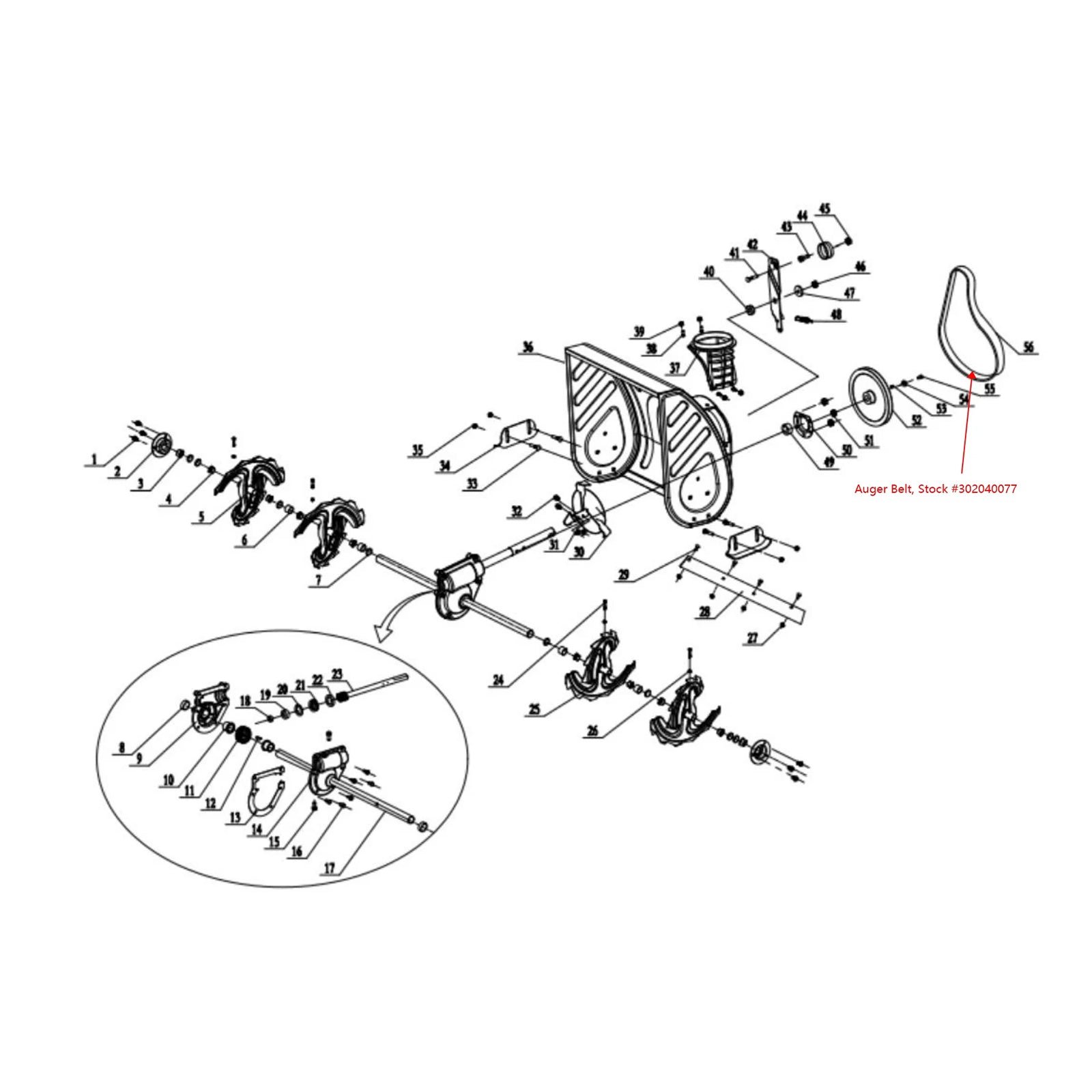
Wear parts are excluded from every snow blower warranty in the market, and the reason is not meanness. A wear part is designed to be consumed.
- Shear pins. These are engineered to break so the gearbox does not. A broken shear pin is the system working correctly.
- Belts. An auger or drive belt is a friction component and it glazes and stretches with use.
- Rubber paddles and scraper bars. On a single stage machine these touch the ground by design and abrade away.
- Skid shoes. They are sacrificial. That is their entire purpose.
- Spark plugs, filters, oil, fuel. Routine consumables.
Also excluded: damage from stale fuel, which is the single most common cause of a declined claim in this category; damage from running without oil; impact damage from hitting a buried newspaper, a hose or a chunk of ice; rust from being stored wet outdoors; and any failure following an unauthorised modification or a removed guard.
Stale fuel deserves its own sentence. Ethanol blended gasoline absorbs water and degrades within about thirty days. Left in a carburettor over a summer it turns to varnish, and the resulting no start is a maintenance failure rather than a defect. Our snow blower repair guide covers correct off season storage and it will save you more than it costs to read.
How to make a claim
Five steps, and the first one saves the most time.
- Check the simple causes first. A machine that will not throw snow usually has a broken shear pin or a slipping belt, both of which are cheap parts you can fit in twenty minutes. A machine that will not start usually has stale fuel.
- Find the serial number. It is on a plate on the chassis, typically at the rear or under the handle. Photograph it.
- Write to us through the contact page with the order number, the serial number, what the machine is doing and a photograph or short video of the fault. A ten second video of a noise is worth three paragraphs of description.
- We open the claim with the manufacturer and tell you the outcome. Most part level claims are approved within two business days.
- We ship the remedy. Part, replacement machine or refund.
You do not need to produce a receipt. We hold your purchase date and serial number against your order, which is one of the purposes listed in our privacy policy. If you bought the machine elsewhere we cannot administer the claim and you will need to go to that retailer.
Maintenance, and how not to void your cover
A snow blower warranty assumes the machine is maintained as the manual specifies. It does not require you to use a dealer, and any retailer implying otherwise in Canada is on thin ice with the Competition Bureau Canada.
You can service your own machine. You can fit your own belt, change your own oil and replace your own paddles without affecting cover, provided the parts are equivalent to the originals and the work is done correctly. Keep receipts for parts and a rough note of dates.
The four things that actually void cover are: running without oil, running stale or contaminated fuel, modifying the machine or removing a safety device, and continuing to run a machine after a fault appears. That last one turns a small covered failure into a large uncovered one, so stop and ask.
| Task | Interval | Affects the warranty if skipped? | Cost if you do it |
|---|---|---|---|
| Fresh fuel or stabiliser | Every fill in season | Yes, a common decline reason | A few dollars |
| Engine oil change | Annually or 50 hours | Yes | Under $20 |
| Check belt tension | Start of season | No, but prevents damage | Free |
| Check shear pins | Start of season | No | A few dollars |
| Grease auger shaft | Annually | No, but prevents seizure | Free |
| Drain fuel for storage | End of season | Yes | Free |
Battery machines and the separate battery term
A cordless machine has two warranties. The tool itself typically carries three to five years. The battery pack carries two to three, and the two clocks are independent.
Battery cover is about defects, not about capacity fade. Every lithium pack loses capacity with cycles and with cold, and a pack that delivers eighty percent of its original runtime after two hundred cycles is behaving normally, not failing. A pack that will not accept a charge at all, shows a cell fault, or dies inside its term is a defect and is covered.
Cold weather performance is the most common battery complaint we see and it is almost never a defect. A pack at minus twenty delivers materially less usable energy than the same pack at plus five. Store batteries indoors and fit them to the machine when you go out. Our battery snow blowers listings state the tested cold weather runtime rather than the laboratory figure.
Statutory rights outlive the warranty term
This is the section most warranty pages leave out, and it is the one that protects you most.
Provincial consumer protection legislation across Canada implies conditions into a sale that a manufacturer’s term cannot shorten: the goods must be of acceptable quality, must match their description, and must be durable for a reasonable period given their price and nature.
Reasonable durability is the important phrase, because it is not tied to the warranty length. A two thousand dollar two stage machine that fails structurally in its fourth season may well fall short of what a court would consider reasonable, even though the manufacturer’s term ended in year three. That claim runs against us as the seller, not the manufacturer.
We do not hide behind the term. If a machine has failed in a way that a machine of that price plainly should not have, tell us and we will look at it on the merits. If we disagree, Consumer Protection Ontario and the equivalent offices in other provinces will hear you free of charge, and the terms and conditions confirms that nothing in our agreement blocks that route.
Selling the machine on, and extended plans
Most residential snow blower warranty terms are not transferable. If you sell the machine, the remaining cover generally ends. A few manufacturers allow a one time transfer within the original term, and we will tell you which if you ask before selling.
We do not sell extended warranty plans. That is a deliberate choice rather than an oversight. For equipment used a few dozen hours a season, the arithmetic on most extended plans favours the seller heavily, and the money is better spent on a set of spare wear parts and fresh fuel discipline.
What we do instead is stock the parts. A machine you can keep running is worth more than a plan that pays out once. Our snow blower parts catalogue lists 244 components with manufacturer stock numbers, and the four that strand most machines in January cost less together than a year of most extended plans.
Certification marks on the machine are a separate assurance from the warranty. Electrical equipment sold in Canada carries a recognised certification, most commonly from CSA Group. That mark speaks to safety compliance, not to whether a gearbox will last. Related pages: the returns and refunds policy for a change of mind, the shipping and delivery policy for how a replacement reaches you, and the payment and security page for how a refund is issued.
Common questions
How long is the warranty on a snow blower?
Typically two to three years for residential use on a gas machine, three to five years on a cordless tool with two to three on the battery pack. Commercial use usually reduces it to ninety days. Your exact term is in the manual and on your order confirmation.
Are belts and shear pins covered?
No. Wear parts are excluded from every snow blower warranty in the market because they are designed to be consumed. A shear pin breaking is the machine protecting its gearbox, which is the system working correctly.
Does servicing it myself void the warranty?
No. You can fit your own belt, change your own oil and replace paddles without affecting cover, as long as parts are equivalent and the work is done properly. Any retailer telling you otherwise in Canada is on thin ice with the Competition Bureau.
What actually voids the cover?
Running without oil, running stale or contaminated fuel, modifying the machine or removing a safety device, and continuing to run it after a fault appears. Stale fuel is by far the most common declined claim in this category.
Do I need to keep my receipt?
No. We hold your purchase date and serial number against your order, so a claim only needs the order number and a photograph of the serial plate. If you bought elsewhere, that retailer administers the claim.
My battery does not last as long as it used to. Is that covered?
Usually not. Capacity fade with cycles and cold is normal lithium behaviour, not a defect. A pack that will not accept a charge at all, shows a cell fault, or dies inside its term is a defect and is covered.
What happens when the warranty expires?
Your statutory rights continue. Provincial law requires goods to be durable for a reasonable period given their price, which is not tied to the manufacturer’s term. A structural failure in year four on an expensive machine is still arguable, and that claim runs against us as the seller.
Do you sell extended warranty plans?
No, deliberately. For equipment used a few dozen hours a season the arithmetic favours the seller. We stock the wear parts instead, and the four components that strand most machines cost less together than a year of most plans.