
The two stage against three stage question comes up once someone has already accepted they need more than a single stage machine. It is a narrower decision than it looks, and for most Canadian driveways the honest answer is that the third stage is not worth the money. This page sets out exactly what the accelerator adds, when it earns its price, and when a large two stage machine is the better buy.
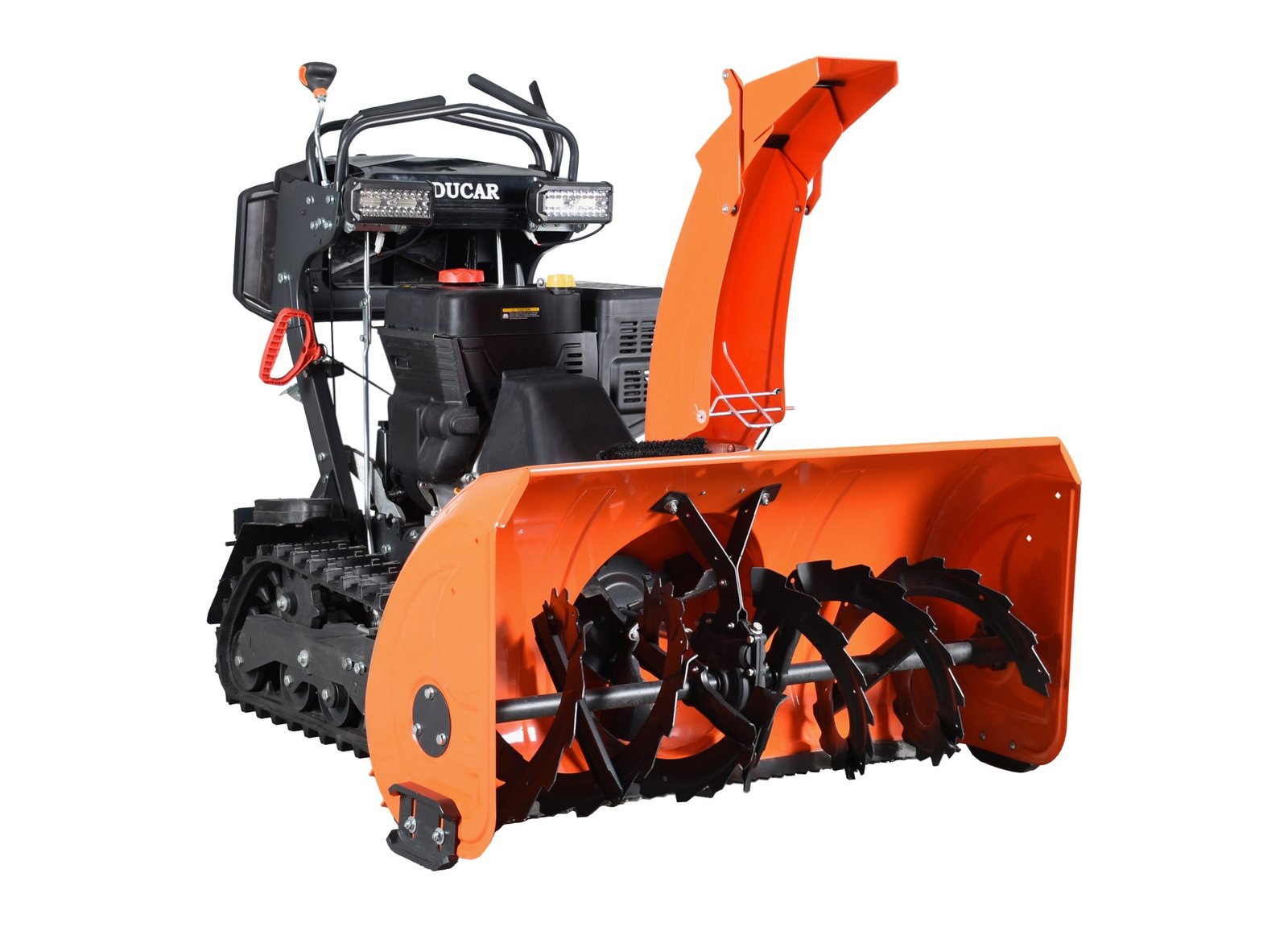
Canadian standards for outdoor power equipment are published by the CSA Group. Price 2 stage vs 3 stage snow blower against extra width instead.
The actual mechanical difference
A two stage machine has an auger that gathers snow and an impeller that throws it. A three stage machine has both of those plus an accelerator sitting between them. Most 2 stage vs 3 stage snow blower comparisons skip this point.
The accelerator is a high speed rotor mounted in the centre of the auger housing. Snow reaching the middle of the housing meets it before the impeller. It chops compacted material, breaks up ice chunks, and pushes the result rearward into the impeller at speed rather than letting the impeller pull it in on its own.
The benefit is not raw power. It is flow. An impeller fed with pre broken, already moving snow can work continuously instead of stalling and recovering, which is what causes a two stage machine to clog when the snow is dense and wet.
Side by side
| Two stage | Three stage | |
|---|---|---|
| Mechanism | Auger, then impeller | Auger, accelerator, then impeller |
| Safe on gravel | Yes, shoes set correctly | Yes, shoes set correctly |
| Cuts a plow ridge | Yes | Yes, faster and with less clogging |
| Dry powder | Excellent | Excellent, difference is small |
| Wet heavy snow | Can clog, needs slower passes | Clearly better |
| Throw distance | Long | Longer, most noticeable in wet snow |
| Weight | Heavy | Heavier |
| Price | Lower | Higher |
| Parts to wear | Auger, impeller, belts, shear pins | The same plus the accelerator assembly |
| Right for | Most Canadian driveways | Acreage, long lanes, severe wet snow |
Read the wet snow row twice. That is the row the third stage is sold on, and it is the row where the claim is genuinely true. Anyone weighing 2 stage vs 3 stage snow blower should start here.
When the third stage is worth it
There are four situations where the extra money is defensible. Weigh 2 stage vs 3 stage snow blower on how often you clear.
- Heavy wet snow is normal for you. Coastal and lake effect regions get dense snow that clogs two stage machines. This is the strongest case.
- You clear acreage or a long rural lane. When a clear takes an hour rather than fifteen minutes, throughput compounds into real time saved every storm.
- The municipal plow leaves a large refrozen ridge every single storm. Not a modest bank, a wall. The accelerator chews that with far less stalling.
- You clear several properties. A driveway plus a parent house plus a shared lane changes the arithmetic entirely.
Notice that three of those four are about volume of work, not difficulty. The third stage buys throughput. If you are not moving a lot of snow repeatedly, you are buying capacity you will not use.
When it is not
Most of the time, and it is worth being blunt about why.
On a standard two car driveway a competent two stage machine finishes in ten to twenty minutes. A three stage machine might save two or three of those minutes in average snow, and nothing at all in dry powder. Against a price difference that is often several hundred dollars, that is a poor trade for a saving you notice twenty times a winter at most.
The costs are real and immediate: more weight to turn at the end of every pass, a larger storage footprint, and one more driven assembly that can wear or jam. A heavier machine also gets used less, which is the quiet failure mode of overbuying.
If your driveway is paved, standard sized, and the plow leaves a normal bank, buy the two stage machine and spend the difference on a second set of shear pins, a spare belt and a cover. That combination will serve you better across ten winters than the third stage will.
The plow ridge case
The ridge is the single hardest thing most Canadian driveways face, so it deserves its own answer.
A single stage machine cannot cut it. It rides up over compacted, part refrozen snow and leaves it. That is the dividing line between single and two stage, and it is not close.
A two stage machine cuts a ridge perfectly well, taken sensibly. Half width bites, low ground speed, and let the auger work. Where it struggles is a large ridge that has thawed and refrozen into something closer to ice than snow, which will stall the impeller and force you to back off and retry.
A three stage machine handles that same ridge with noticeably less stalling. So the question is not whether a two stage machine can do it, but how often you face the worst version of it. Once or twice a winter, take it slowly. Every storm, all winter, consider the upgrade.
Either way, expect to break the occasional shear pin at the ridge. That is what they are for, and replacing one is a ten minute job.
What extra you maintain
A third stage is one more driven assembly, and it is fair to know what that adds before buying.
| Item | Two stage | Three stage |
|---|---|---|
| Shear pins | Auger shaft | Auger shaft, and often the accelerator too |
| Belts | Auger and drive | Auger and drive, sometimes an extra |
| Bearings | Auger ends, impeller | The same plus the accelerator |
| Gearbox | One | One, working harder |
| Seasonal routine | Standard | Standard, with more points to grease |
Nothing there is exotic and nothing there is expensive individually. There is simply more of it, and more places for grit and salt to reach. If you are the kind of owner who greases fittings in October, this costs you fifteen minutes a year. If you are not, it is one more thing that will seize.
Wear parts for both types are listed by manufacturer stock number on the parts catalogue, and the seasonal routine is in the maintenance checklist.
Width beats stages, almost always
If you have a fixed budget and you are choosing between more stages and more width, take the width. This is the most useful thing on the page and the least often said.
Clearing time is driven by the number of passes, and passes are set by width. Stages change how well the machine copes with difficult snow, not how much ground it covers per pass. On an average driveway in average snow, a wider two stage machine finishes sooner than a narrower three stage one.
| Driveway | 24 inch | 28 inch | 34 inch |
|---|---|---|---|
| Two car, standard | About 10 passes | About 9 passes | About 7 passes |
| Two car, double length | About 21 passes | About 17 passes | About 14 passes |
| Rural lane | Slow going | Workable | Comfortable |
Our petrol range runs from 21 inch single stage machines up to a 42 inch tracked stand on unit, with 28, 30 and 34 inch two stage machines in between. Within that range, moving up in width is usually cheaper per minute saved than moving up in stages.
The limit on width is not money, it is storage and turning. Measure the gate and the shed door before you order, because a machine that does not fit where it lives gets used less, and a machine you dread turning gets used later in the storm than it should.
What to buy instead of the third stage
If you have the budget of a three stage machine and a driveway that does not need one, here is where that money does more good.
- More clearing width. Covered above, and the single best return.
- Tracks instead of wheels. If your driveway slopes or ices up, traction changes the experience far more than throughput does. We stock four tracked machines.
- Electric start and heated grips. Unglamorous, and the features owners actually mention after a season.
- A proper spares kit. Shear pins, an auger belt at $20.91, a scraper bar and a spare plug. That kit prevents nearly every mid winter breakdown, and it costs a fraction of a stage.
- A cover and somewhere dry. Salt and damp end more machines than snow does.
Every one of those is a smaller line item than the third stage and every one of them you will notice more often. Pricing across the range is on the Canadian price guide, and reduced machines appear on the sale page.
Cordless two stage, the option that changes this
One recent development reframes the whole question. Two stage capability is no longer tied to a petrol engine.
An 80 volt cordless two stage machine cuts a plow ridge and works on gravel exactly as a petrol two stage does, because the mechanism is identical. What differs is runtime and the absence of fuel, stabiliser, oil changes and spring servicing. For a driveway that genuinely needs two stage capability but where the owner would rather not maintain an engine, that combination did not exist a few years ago and now does.
The trade is capacity. Packs are finite, and wet snow draws current far faster than dry powder, so a long clear may need a swap. The honest planning number is the wet snow figure, not the manufacturer headline.
Our electric side runs 27 Greenworks and 25 Snow Joe machines against 15 Ducar petrol, so this is a mainstream option here rather than a curiosity. Before choosing three stage petrol, it is worth pricing a cordless two stage machine with a second pack against it, particularly if noise or garage storage matters to you.
See the battery range.
The 2 stage vs 3 stage snow blower verdict
To summarise: 2 stage vs 3 stage snow blower comes down to matching the machine to the surface, the snowfall and the space you have to store it. Everything above is the detail behind that. If any of it is unclear for your property, ask us rather than guessing. The 2 stage vs 3 stage snow blower decision turns on this row.
The verdict
Buy the two stage machine unless one of these is true: heavy wet snow is routine where you live, you are clearing acreage or a long lane, the plow leaves a wall rather than a bank every storm, or you clear more than one property. For most driveways the 2 stage vs 3 stage snow blower answer is two.
If none of those apply, a good two stage machine in the right width will clear your driveway for a decade, and the money saved is better spent on width than on stages. A 28 inch two stage machine will beat a 24 inch three stage one on a normal driveway almost every time, because width removes passes and passes are what take the time.
If you are torn, tell us the driveway dimensions, the surface, and what the plow typically leaves, through the contact page. We would rather talk you down a class than sell you capacity you will not use.
Common questions
Is a 3 stage snow blower worth it over a 2 stage?
For most Canadian homes, no. A three stage machine costs more, weighs more and is more complex, and on a standard two car driveway it will not finish meaningfully faster. It earns its price on acreage, long rural lanes, and in regions where heavy wet snow is routine. If your driveway takes a two stage machine under twenty minutes, the third stage is buying you very little. That is the core of the 2 stage vs 3 stage snow blower question.
What does the third stage actually do?
It adds an accelerator between the auger and the impeller. The accelerator chops and compresses snow before it reaches the impeller, so the impeller receives material that is already broken up and moving. That reduces clogging in dense wet snow and increases throughput. Ask us before settling 2 stage vs 3 stage snow blower.
Does a 3 stage snow blower throw further?
Generally yes, because snow arrives at the impeller pre accelerated. The difference is most noticeable in wet heavy snow, which is exactly where a two stage machine loses distance. In dry powder both types throw a long way and the gap narrows.
Are three stage machines harder to maintain?
There is one more driven assembly to wear, and one more place for a shear pin or a bearing to fail. Nothing about it is exotic, but there is more of it. Weigh that against how often you will actually use the extra capability.
Which is better for a plow ridge?
Both cut a plow ridge, which is the main advantage either has over a single stage machine. A three stage machine will chew a large refrozen ridge faster and clog less doing it. If the ridge is the worst thing your driveway faces and it is large every storm, that is the strongest argument for the third stage.
For the full explanation of what each stage does, read stages explained. For the more common decision one step down, see single stage against two stage, and browse the two stage range.