
The honest answer is that most Canadian buyers overspend on this decision, and a smaller number badly underspend and regret it by January. The single stage vs two stage snow blower question is not really about how much snow falls where you live. It is about two things almost nobody mentions in a product listing: what your driveway is made of, and whether a municipal plow drops a bank across the end of it. Get those two right and the rest follows.
On this page
- The mechanical difference, in one paragraph
- What a single stage machine does well
- Where a single stage machine runs out of road
- What the second stage actually buys you
- The plow ridge is usually the real decider
- Your surface decides more than your snowfall does
- Single stage vs two stage snow blower compared side by side
- What each costs in Canada
- How your city changes the answer
- Three stage machines, and why we do not stock them
- Choosing in ninety seconds
- Frequently asked questions
The mechanical difference, in one paragraph
The whole single stage vs two stage snow blower question comes down to one structural choice. A single stage machine has one moving part that matters: a rubber tipped auger that spins, touches the ground, scoops the snow and flings it out of the chute in the same motion. One stage, one action. Because the auger contacts the surface, it scrapes down close to bare pavement, and the contact also drags the machine forward so you are guiding rather than shoving.
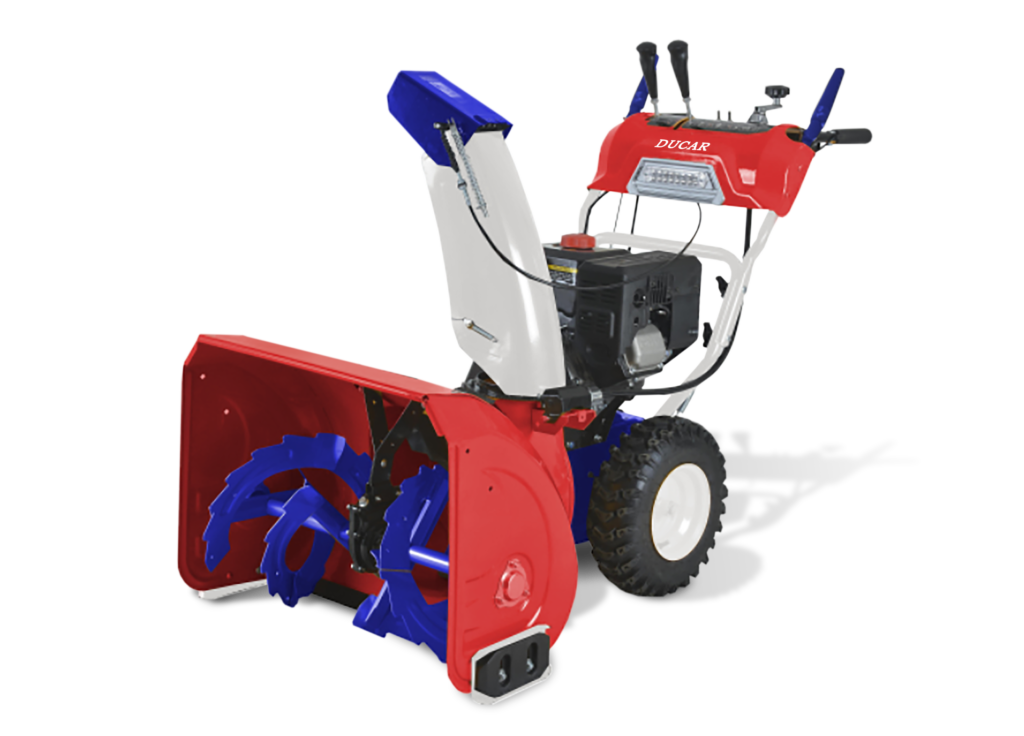
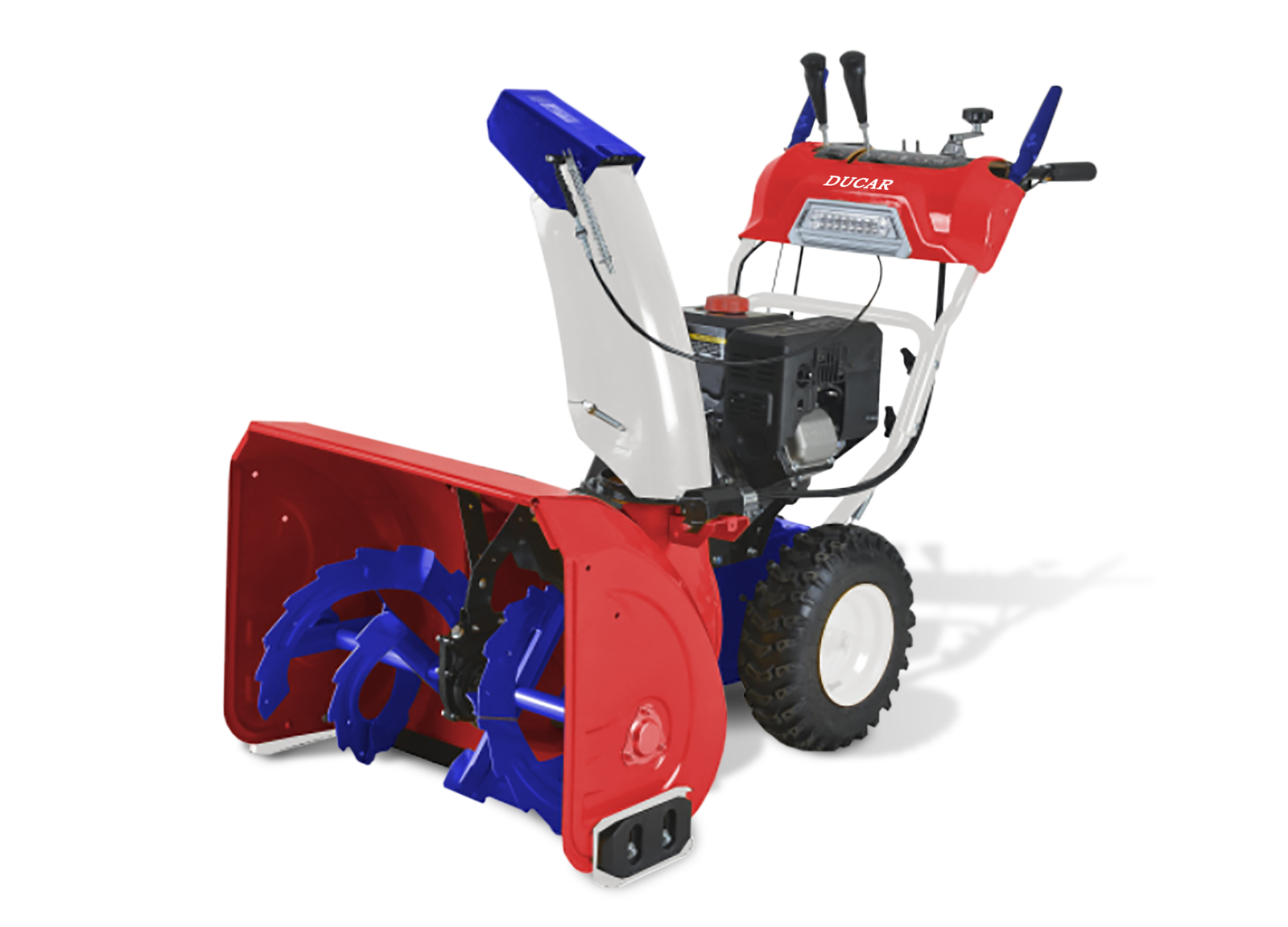
A two stage machine splits that job. A slower, heavier steel auger gathers snow and feeds it inward to a separate high speed impeller mounted behind it. That impeller is the second stage, and it is the part that actually throws. The auger never touches the ground. It rides above the surface on adjustable skid shoes, and the machine moves because the wheels or tracks are driven by the engine.
That single structural difference, whether the auger touches the ground, cascades into every practical difference between the two. It decides what surface you can use, how deep a fall you can take in one pass, how far the snow goes, what the machine weighs and what it costs.
What a single stage machine does well
A single stage machine is genuinely the better tool in a set of conditions that describes a lot of Canadian households, and the industry is not keen to say so.
It clears to the surface. Because the auger sweeps the ground, it leaves a paved driveway close to bare, which matters more than throwing distance for most people. A two stage machine deliberately leaves a thin layer behind, and on a mild day that layer turns to slush and then to ice overnight.
It is light enough to handle. Most single stage units sit well under 50 kg, which means you can turn one at the end of a pass without planting your feet, lift it over a step, and stand it against a wall rather than surrendering a parking bay to it for eight months of the year.
It is cheap to buy and cheap to keep. There is no gearbox, no friction disc, no drive belt to the wheels, and on the electric and battery models there is no fuel system to gum up over summer. Our corded electric single stage units start at $320.56, against $1,625.00 for the smallest two stage machine we hold. That gap buys a lot of shovelling.
If your driveway is paved, short to medium, and your city sits under roughly 150 cm a season, a single stage machine is very likely the right purchase. You can check the specifics on our snow blower size calculator, which sizes from your actual city, driveway dimensions and surface rather than from a generic chart.
Where a single stage machine runs out of road
In the single stage vs two stage snow blower decision, there are four situations where a single stage machine stops being a bargain and starts being a problem.
Depth. Past roughly 20 cm in a single fall you are taking half depth passes. The machine can physically do it, but you have doubled your passes and removed the labour saving that justified the purchase.
Wet snow. Heavy wet snow sticks inside the auger housing, and a single stage machine has no impeller to force it out. It clogs. Clearing a clogged chute is the most common way people injure themselves with this equipment, and it should always be done with the engine off and a clearing tool, never a hand.
Gravel or loose surfaces. The auger contacts the ground, so on gravel it picks up stones and throws them. This is not a tuning problem, it is what the design does.
The plow ridge. Covered below, because it is the one that catches most people out.
What the second stage actually buys you
The impeller changes the machine from something that sweeps snow to something that processes it. Practically, that means four things.
It handles depth. A two stage machine takes a 40 cm fall in one pass without complaint, because the auger only has to feed the impeller rather than throw anything itself.
It throws far. Ten to fifteen metres is normal, which matters more than it sounds on a wide driveway, where a short throw just means relocating the same snow twice.
It clears packed and icy snow. The steel auger breaks a compacted bank apart rather than riding over it.
It drives itself. Two stage machines have driven wheels or tracks and real gear selection, which is what makes a long or sloped driveway tolerable. Our tracked units in particular hold a line on a slope where wheels slip.
The cost is bulk, weight, price and maintenance. You are also now maintaining shear pins, which are a wear part by design. They are meant to break so the gearbox does not. If you own a two stage machine, keep spares before you need them, and read our guide to snow blower shear pins.
The plow ridge is usually the real decider
If you take one thing from this page, take this. The single biggest predictor of whether a single stage machine will disappoint you is not your city’s snowfall total. It is whether a municipal plow passes your driveway.
When the plow clears your street it pushes a bank of compacted, partly melted, refrozen snow across the end of every driveway on the road. That ridge is dense in a way fresh snow never is. A single stage machine climbs onto it and spins, because the auger cannot bite into packed material and there is no impeller behind it to clear what it does gather.
This is why two people in the same city with the same driveway can have completely opposite experiences with identical machines. The one on a plowed street fights the ridge every storm. The one on a private lane or a cul de sac cleared later never meets it.
If the plow reaches you, buy two stage, even for a short driveway. If it does not, your snowfall total and your surface decide.
Your surface decides more than your snowfall does
Surface settles the single stage vs two stage snow blower question more often than snowfall does, and it is a hard constraint rather than a preference, and it is worth being blunt about it.
On gravel, loose stone or an unsealed lane, you need a two stage machine. There is no configuration of a single stage unit that makes it safe on gravel, because ground contact is how it works.
On interlock, pavers or a sealed driveway, either type works, but set the skid shoes on a two stage machine to leave clearance. Set too low, a steel auger housing will scar pavers and lift the sand from the joints over a season. This is the most common avoidable damage we hear about.
On plain asphalt or concrete, both work, and a single stage machine will leave a cleaner surface.
Single stage vs two stage snow blower compared side by side
| Factor | Single stage | Two stage |
|---|---|---|
| Auger contacts ground | Yes, by design | No, rides on skid shoes |
| Comfortable snow depth | Up to about 20 cm | 40 cm and beyond |
| Gravel driveway | Not safe | Yes |
| Packed plow ridge | Rides over it | Cuts through it |
| Throw distance | Roughly 3 to 8 metres | Roughly 10 to 15 metres |
| Self propelled | Auger assist only | Driven wheels or tracks |
| Leaves surface | Close to bare | Thin layer remains |
| Typical weight | Under 50 kg | 90 kg and up |
| Storage footprint | Stands against a wall | Takes a parking bay |
| Wear parts to keep | Scraper bar, paddles | Shear pins, belts, skid shoes |
| Our current price from | $320.56 | $1,625.00 |
What each costs in Canada
Price is where the single stage vs two stage snow blower gap is starkest. The figures below are what we hold at the time of writing, so you can see the real shape of the decision rather than a range invented for an article.
At the entry point, a corded electric single stage machine at 22 inches runs $320.56. There is no fuel, no oil and no winter starting ritual, and the trade is that you are managing a cord.
A battery single stage at 22 inches is $849.00 with a 5.0Ah battery and charger, or $699.99 as a tool only unit if you already own the platform. Cold reduces runtime, which matters more in Edmonton than in Toronto.
The smallest two stage machine we hold is a 28 inch, 252 cc unit at $1,625.00 with electric and recoil start and heated grips. From there the ladder runs to a 30 inch at $1,799.00, a 34 inch at $1,999.00, and a tracked 34 inch at $2,399.00.
The honest summary is that the step from single to two stage is roughly a fivefold price increase. It is worth it when your surface or your plow ridge demands it, and it is money badly spent when neither does. Full pricing sits on our snow blower prices in Canada page, and current stock is in the shop.
How your city changes the answer
Annual snowfall shifts where the line falls. These are the figures we publish on our city pages, drawn from long run climate records rather than from a single winter.
| City | Annual snowfall | Sensible starting point |
|---|---|---|
| Sudbury | 267 cm | Two stage, no real argument |
| Barrie | 253 cm | Two stage |
| Ottawa | 223 cm | Two stage |
| Kitchener | 160 cm | Either, plow ridge decides |
| Calgary | 129 cm | Single stage unless gravel |
| Edmonton | 124 cm | Single stage, but cold cuts battery runtime |
| Toronto | 115 cm | Single stage for most paved drives |
| Winnipeg | 114 cm | Single stage, though cold holds accumulation |
Two cities with near identical totals can still need different machines. Calgary and Edmonton are within 5 cm of each other, but Calgary’s chinook cycle drives thaw and refreeze, so Calgary fights ice while Edmonton holds accumulation. If you want the underlying climate record rather than our summary, Environment and Climate Change Canada publishes the Canadian Climate Normals for every station in the country.
Three stage machines, and why we do not stock them
Three stage machines add a third accelerator ahead of the auger to feed snow inward faster. They exist, they are genuinely quicker on very large properties, and we do not currently stock them, so treat what follows as information rather than a pitch.
For a residential driveway the gain is marginal. You are paying for throughput on a job whose limit is usually how fast you walk, not how fast the machine ingests. The extra assembly is another wear point. Unless you are clearing a long rural lane or several properties in one run, a well chosen two stage machine does the same work for less money. Our 2 stage vs 3 stage comparison goes into the detail.
Choosing in ninety seconds
Four questions settle the single stage vs two stage snow blower choice, in order. The first one to say two stage wins.
Is the driveway gravel or loose stone? If yes, two stage. Stop here.
Does a municipal plow leave a ridge across the end? If yes, two stage. Stop here.
Does your city average more than about 150 cm a season? If yes, two stage is the safer buy.
Is the driveway longer than about 15 metres or noticeably sloped? If yes, take the self propelled two stage machine, and consider tracks on a slope.
Four no answers means a single stage machine will serve you well and save you well over a thousand dollars. If you want it worked through against your own measurements, the size calculator does exactly this, and it will tell you when a shovel is enough. For the wider decision, see our snow blower buying guide for Canada, or browse single stage machines and two stage machines directly.
Whichever you buy, read the manual on safe chute clearing before the first storm. The Outdoor Power Equipment Institute publishes plain snow thrower safety guidance that takes two minutes and covers the injury that sends people to hospital every winter.
Frequently asked questions
Is a two stage snow blower worth it for a small driveway?
Usually not, if the driveway is paved and you are somewhere with under about 150 cm a season. A two stage machine is heavier, wider to store and more expensive to maintain. The exception is the plow ridge. If the municipal plow leaves a packed bank across the end of your drive, that bank will stop a single stage machine no matter how short the driveway is.
Can a single stage snow blower handle wet heavy snow?
It can move it, but slowly, and it is the situation most likely to clog the chute. Wet snow sticks to the auger housing. A single stage machine has no impeller to force that snow out, so it relies on auger speed alone. If you regularly get wet coastal or lake effect snow, size up.
Do I need a two stage machine for a gravel driveway?
Yes. A single stage auger contacts the ground by design, which is how it clears down to the surface. On gravel it picks up stones and throws them at whatever is nearby. A two stage machine rides on skid shoes above the surface, so it leaves the gravel where it is.
What does the second stage actually do?
The auger gathers snow and feeds it to a separate high speed impeller, which is the second stage. The impeller is what throws the snow, and it is why a two stage machine clears a bank a single stage machine simply rides over.
How much snow is too much for a single stage snow blower?
As a working rule, roughly 20 cm of fresh snow in one fall. Beyond that you are taking half depth passes, which doubles the work and removes most of the reason you bought a machine.
Is a single stage snow blower self propelled?
Almost never in the sense a two stage machine is. The spinning auger contacts the ground and pulls the machine forward, which helps, but you are still steering and pushing. Two stage machines usually have driven wheels or tracks with real gear selection.