
Snow blowers break on the worst night of the year. That is not bad luck, it is selection bias: you only use the machine when conditions are severe. The good news is that most failures are five predictable faults, and three of them you can fix in the driveway in under fifteen minutes. If a snow blower repair is what you are after, this is the listing and these are the details worth knowing.
On this page
- It will not start
- It runs but throws no snow
- The auger turns but snow dribbles out
- It will not self propel
- It pulls to one side or scrapes
- What to keep in the garage
- When to call a shop
- Common questions
- A seasonal service schedule that actually prevents breakdowns
- Fault patterns by machine type
- What repairs typically cost in Canada
- Safety, stated plainly
- Finding a shop near you
- Diagnosing by symptom, quickly
- Tools worth owning
- Why September matters
- Keeping records
- One last habit worth forming
It will not start
Nine times out of ten this is fuel, not the engine. In order:
- Stale fuel. Petrol older than about 30 days without stabiliser starts to varnish. Drain it and refill with fresh. This alone fixes most no start calls in November.
- Fuel valve closed. Obvious, easy to miss, worth ten seconds.
- Choke and primer. Cold start needs full choke and three to five primer presses. Too many presses floods it, then you need to wait.
- Spark plug. Pull it. Wet and black means flooded or too rich. Cracked porcelain means replace it. Plugs are inexpensive and a yearly plug is cheap insurance.
- Carburettor. If it ran badly at the end of last winter and worse now, the carb bowl has varnish in it. Cleaning is straightforward on most machines. This is the point where many people call a shop, reasonably.
It runs but throws no snow
Almost always a sheared shear pin. They are designed to break so the auger gearbox does not. Replacement takes minutes with the right pin.
Use the correct pin. Substituting a hardware store bolt is the single most expensive mistake in snow blower ownership, because a grade 5 bolt will not shear, and the gearbox breaks instead. Keep a set of the right pins in the garage.
If the pins are intact and the auger still will not turn, suspect the auger belt.
The auger turns but snow dribbles out
A packed chute, or wet snow beyond the machine capability. Shut the engine off, wait for everything to stop, and clear the chute with the clearing tool, never your hand. Auger and impeller store energy and can turn after the engine stops. This causes serious hand injuries every winter in Canada.
If it happens constantly in wet snow, the machine is undersized for your conditions rather than faulty. See single stage vs two stage.
It will not self propel
Usually the friction disc or the drive belt. Friction discs are a wear item, especially if the machine is stored damp. Both are routine replacements at a small engine shop and inexpensive parts.
It pulls to one side or scrapes
Check skid shoe height, they wear unevenly, and the scraper bar. Both are consumables and both are cheap. A worn scraper bar leaves a layer of snow behind on every pass and is often mistaken for a power problem.
What to keep in the garage
- A set of the correct shear pins for your model
- A spare auger belt and drive belt
- A spare spark plug
- Fuel stabiliser
- The chute clearing tool, clipped to the machine where it belongs
That is under a hundred dollars of parts and it covers most of what will actually stop you mid storm.
When to call a shop
Call a small engine repair shop for gearbox noise, a bent auger or impeller after hitting something solid, carburettor work you would rather not do, engine knocking, or anything involving the crankshaft. Book early. Every shop in Canada is overwhelmed from the first storm onward, and a machine dropped off in December can sit for weeks.
The cheapest repair strategy in this category is a service booked in September, when shops are empty and turnaround is days.
Common questions
Why will my snow blower not start?
Can I use a regular bolt instead of a shear pin?
Why does my snow blower throw snow poorly?
How much does snow blower repair cost in Canada?
When should I service my snow blower?
Need parts rather than a repair? Browse snow blower parts. If the machine is past economical repair, compare two stage snow blowers or the battery range, which removes fuel problems entirely.
A seasonal service schedule that actually prevents breakdowns
Most snow blower failures are storage failures, not use failures. The machine sits for eight months, then gets asked to work hard in the cold. A short routine at each end of the season removes most of what goes wrong.
September, before the season
- Fresh fuel with stabiliser. Run the engine long enough to draw it through the carburettor.
- Change the engine oil. Cold starts are hard on oil and it is cheap insurance.
- New spark plug, or at minimum pull, inspect and gap the existing one.
- Check shear pins are intact and correct, and that you have spares.
- Inspect belts for glazing, cracking and fraying.
- Check scraper bar and skid shoe wear, and set skid shoe height for your surface.
- Grease the auger shaft zerks if fitted, and the chute rotation gear.
- Check tyre pressures. Uneven pressures make the machine pull to one side.
April, before storage
- Either drain the fuel completely, or fill and stabilise. Half a tank of untreated fuel over summer is the worst option.
- Run the carburettor dry if you are draining.
- Clean packed snow and salt residue out of the housing, then dry it.
- Wire brush and paint any bare metal inside the housing.
- Store off the ground and covered, ideally somewhere that does not swing through dew point every night.
Fault patterns by machine type
Gas single stage
The rubber auger paddles are the main wear item and are often overlooked. When they wear, the machine stops pulling itself forward and throws considerably less, which owners frequently misdiagnose as an engine problem. Paddles are inexpensive and replacing them makes an old machine feel new.
Gas two stage
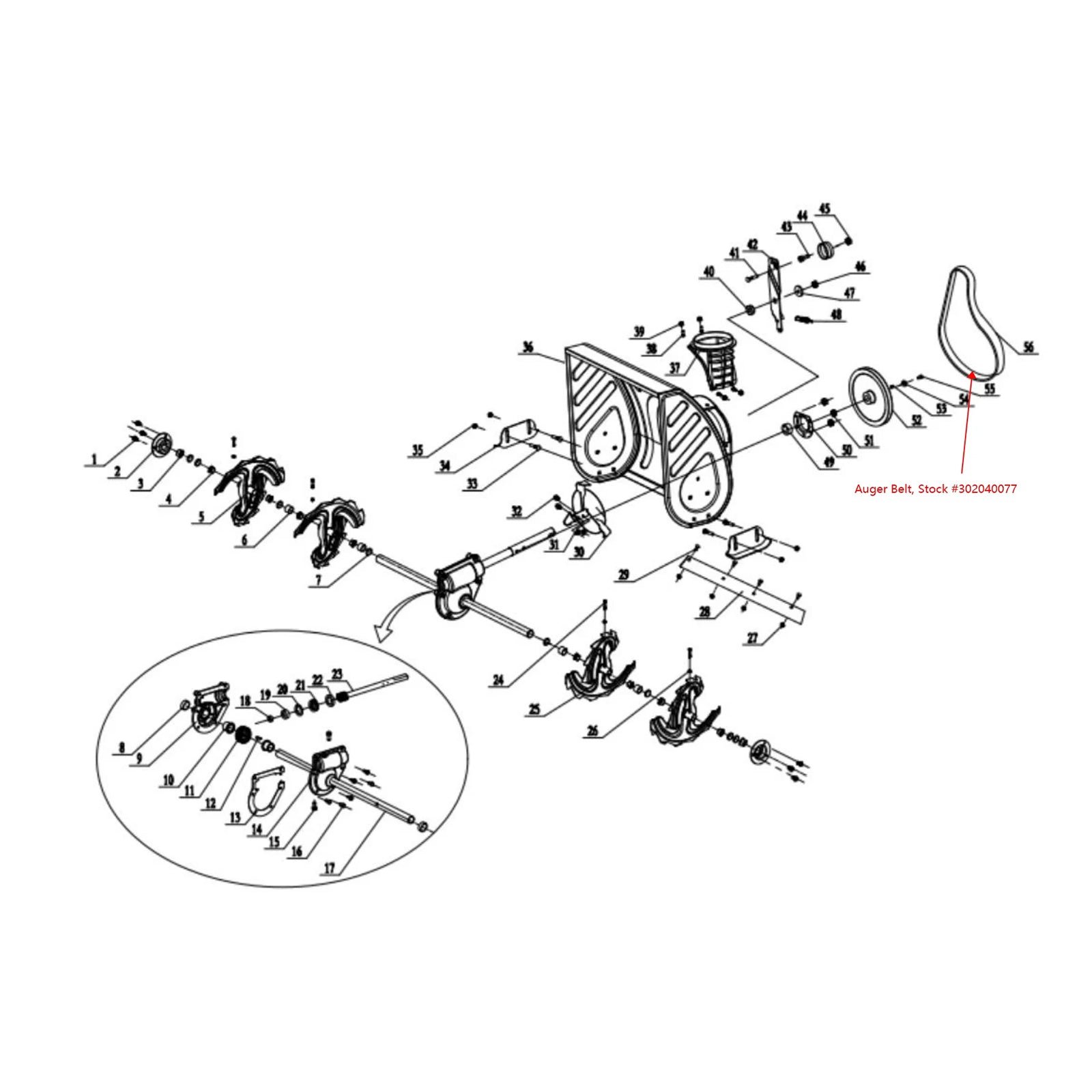
Shear pins, belts and the friction disc account for most failures. Chute cables stretch and seize, particularly if the machine is stored damp. Carburettor issues dominate no start calls, almost always traceable to fuel left over summer.
Battery
Far fewer mechanical failures, but batteries do degrade. Capacity loss shows as shorter runtime long before the pack fails outright. Cold storage accelerates this. Keep packs indoors and above roughly 20 percent charge. The other common issue is packed snow in the auger housing tripping the overload cut out, which is a protection feature rather than a fault.
Tracked machines
Track tension needs checking. Too loose and the track walks off, too tight and you load the bearings. Both are avoidable with a five minute check.
What repairs typically cost in Canada
Rough guidance so you can judge whether a quote is reasonable and whether a repair is worth doing on an older machine.
| Job | Parts | Difficulty |
|---|---|---|
| Shear pin replacement | Very low | Driveway, minutes |
| Spark plug | Very low | Driveway |
| Auger or drive belt | Low | Driveway with patience, or shop |
| Scraper bar / skid shoes | Low | Driveway |
| Single stage paddles | Low to moderate | Driveway with basic tools |
| Friction disc | Moderate | Shop for most owners |
| Carburettor clean or rebuild | Low parts, higher labour | Shop unless confident |
| Auger gearbox | High | Shop. Often uneconomic on old machines |
| Engine rebuild or replacement | Very high | Usually replace the machine |
The rule of thumb most small engine shops use: if the repair approaches half the cost of a comparable new machine and the unit is more than about ten years old, replacement is usually the better decision.
Safety, stated plainly
Snow blower injuries in Canada follow a very consistent pattern and they are almost entirely preventable.
Never put your hand in the chute or the auger housing. Not with the engine off, not after waiting, not quickly. The auger and impeller store rotational energy and can turn suddenly when a blockage releases, even with the engine stopped and the key removed. Use the clearing tool that came with the machine. If it is missing, buy one, they cost very little.
Shut down completely before clearing a blockage. Engine off, key out, and wait for all movement to stop.
Keep the discharge away from people, vehicles, windows and roads. A two stage machine can throw a stone with real force.
Do not run a petrol machine in a closed garage. Carbon monoxide builds faster than people expect, even with the door partly open.
Finding a shop near you
Small engine repair shops across Canada are overwhelmed from the first storm onward. A machine dropped off in mid December can wait weeks, which is precisely when you need it.
Practical approach: search for small engine repair rather than snow blower repair specifically, since the same shops service mowers, generators and chainsaws. Ask whether they are an authorised dealer for your brand, because dealers get parts faster. Ask for the current turnaround before you leave the machine. And book a service in September, when the same shop will turn it around in days.
If the machine is beyond economical repair, we stock parts for common wear items, and you can compare two stage machines or the battery range, which removes fuel and carburettor problems from your life entirely.
Diagnosing by symptom, quickly
A short decision path for the most common complaints.
Engine turns but will not fire: fuel first, then spark. Stale fuel is the overwhelming cause. Pull the plug, check for wet, check for spark against the block.
Starts then dies: almost always a partially blocked carburettor jet or a blocked fuel cap vent. Loosen the cap and try again as a two second diagnostic.
Runs rough under load: fuel delivery or a failing plug. On older machines, check the governor linkage is free.
Auger will not turn: shear pins, then auger belt, then gearbox.
Wheels will not drive: drive belt, then friction disc, then drive cable adjustment.
Machine pulls to one side: uneven tyre pressure, worn skid shoe on one side, or a seized wheel on a differential machine.
Tools worth owning
A basic socket set, a spark plug socket, a set of feeler gauges for plug gapping, a fuel line clamp, a small funnel, and a torque wrench if you intend to do belt or gearbox work. Almost every driveway repair on this page needs nothing beyond the first three.
Why September matters
Shops are empty, parts are in stock nationally rather than backordered, and you find the problem before the season instead of during it. A machine serviced in September gets a two or three day turnaround. The same job in late December can take three weeks, and that is three weeks of clearing your driveway by hand.
Keeping records
Write the date of each oil change, plug replacement and belt change on a label inside the housing cover, or keep a note on your phone. It sounds fussy, but the most common cause of a preventable failure is simply not remembering when something was last done. It also materially helps resale value, because a documented machine sells faster and for more than an identical undocumented one.
A snow blower repair earns its keep on the mornings nobody wants to be outside. That is the test worth applying. Ask what a snow blower repair will do on the worst ordinary morning of your winter rather than on the average one, and the specification you need becomes obvious.
Practical closing thought on this snow blower repair: write the stock numbers inside the cover, buy the consumables in autumn, and store it dry. A snow blower repair looked after that way is a fifteen year purchase.
One last habit worth forming
Run the machine for a minute at the end of every clearing before putting it away. It clears residual snow from the auger housing and chute that would otherwise freeze solid overnight into a block you have to chip out before the next storm. It costs a minute and saves an aggravating fifteen.
Two independent references worth keeping alongside this page. Operator safety guidance for powered snow removal in Canada is published by Canadian Centre for Occupational Health and Safety, and thirty year snowfall normals for your own weather station are published free by Environment and Climate Change Canada. Neither costs anything and both are more useful than most reviews.
The snow blower repair summary
- Who it is for. A snow blower repair suits a specific kind of property, and the specification above is how you tell whether yours is one of them.
- Surface first. Before anything else about a snow blower repair, establish whether the surface is paved or loose. That single fact removes most of the options.
- Depth second. Size a snow blower repair on the depth of a typical single storm rather than on the seasonal total, because those two numbers point at different machines.
- Parts third. A snow blower repair you cannot get consumables for in February is a machine with an expiry date, whatever the badge says.
- Buy in autumn. Every snow blower repair on this site is cheaper to obtain in October than in January, not in price but in the time it takes to arrive.
None of that is complicated, and it is most of what separates a satisfied owner from a frustrated one. If you want the reasoning behind any of it, our buying guides go through each point properly.