
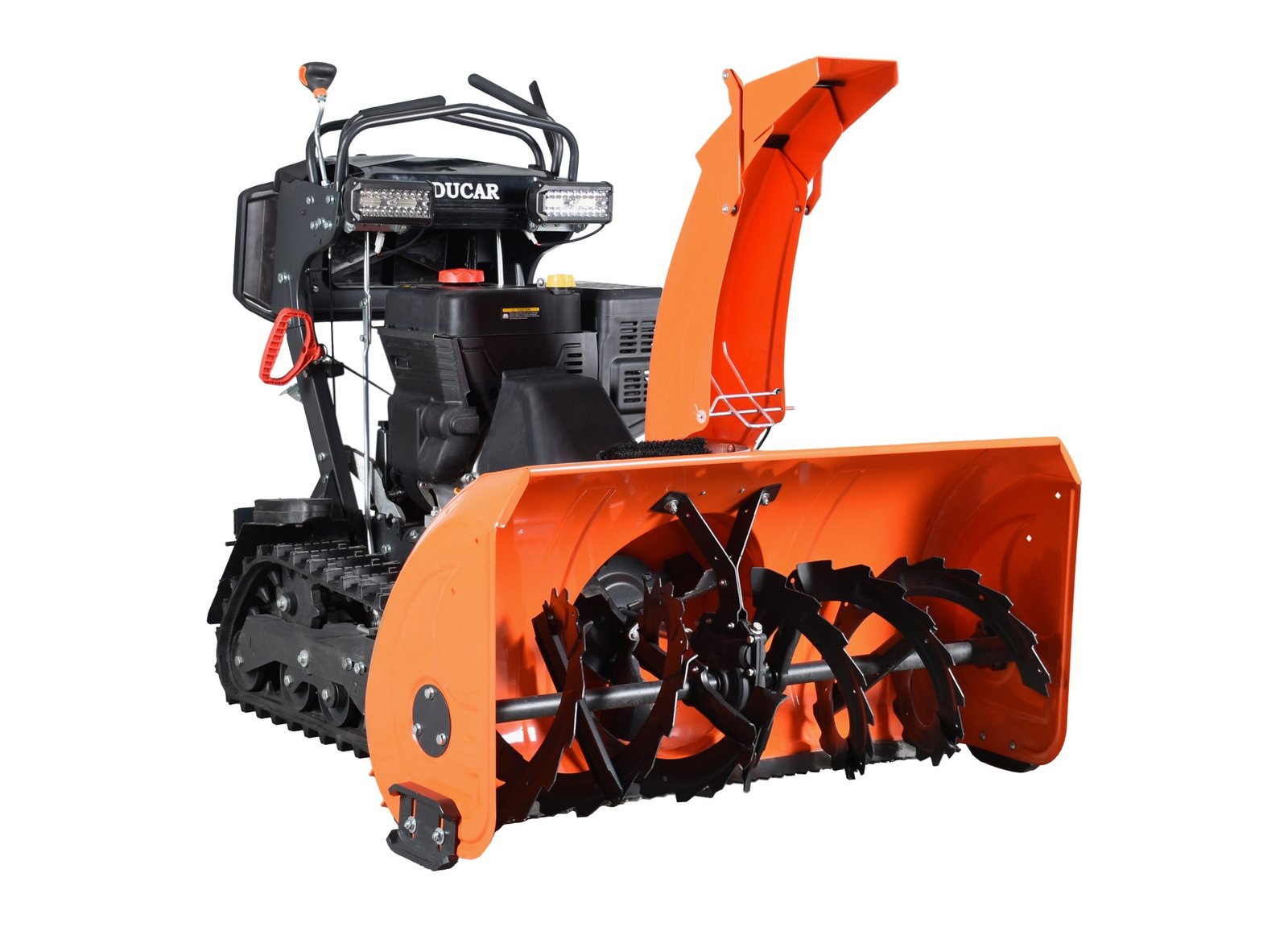
A tracked snow blower trades manoeuvrability for grip. On a sloped driveway, a surface that ices over, or a rural lane, that trade is worth making, and it is the one upgrade owners of hilly properties consistently say they should have bought first. This page covers the four tracked machines we stock, what tracks actually change, and the driveways where wheels remain the better answer.
What tracks actually change
A wheeled snow blower puts two contact patches on the ground, each a few square inches. A tracked snow blower puts down two long rubber belts. The weight of the machine is spread across a much larger area, and that is the whole difference.
Three things follow. Traction improves dramatically on ice, packed snow and slopes, because there is far more rubber gripping. Flotation improves on soft or uneven ground, because the machine sinks less. And the machine becomes tiltable: most tracked units let you adjust the angle of the housing, so you can bite deeper into a plow ridge or lift the auger over an obstacle.
What you lose is ease of turning. A tracked machine does not roll into a turn, it pivots, and that takes effort and space at the end of every pass.
The tracked machines we stock
Four tracked machines, all two stage petrol, all Ducar. Prices are ours in Canadian dollars.
| Machine | Engine | Price | Suits |
|---|---|---|---|
| 26 inch, tracks, electric and recoil start | 252 cc | $1,799 | Sloped suburban driveway |
| 30 inch, tracks, electric and recoil start | 302 cc | $1,949 | Longer sloped or icy driveway |
| 34 inch, tracks, electric start, heated grips | 420 cc | $2,399 | Rural lane, acreage |
| 42 inch stand on, tracks, 12V electric start | 420 cc | $5,999 | Commercial scale, large properties |
Note the pattern: there is no small tracked machine, and there will not be. Tracks add weight and cost that only make sense once the machine is large enough to need the traction. The smallest tracked unit here is 26 inches, which is already a substantial two stage machine.
All four are two stage, which means all four are safe on gravel with the skid shoes set correctly. That is a function of the stages rather than the tracks, and it is covered in stages explained.
Tracked against wheeled
| Tracked | Wheeled | |
|---|---|---|
| Traction on ice | Excellent | Poor to fair, better with chains |
| Slopes | Confident, the main reason to buy | Slips, and can run away downhill |
| Turning at pass ends | Heavy, pivots rather than rolls | Easy |
| Tight spaces | Awkward | Good |
| Weight | Higher | Lower |
| Adjustable bite angle | Yes, tilt the housing | No |
| Price at the same width | Higher | Lower |
| Our range | 4 machines, $1,799 to $5,999 | The rest of the two stage range |
Read the first two rows against your own driveway. If neither describes you, wheels are almost certainly the better buy, and the money is better spent on extra clearing width.
When a tracked snow blower is right
Four situations where the extra cost and weight are clearly justified.
- Any meaningful slope. A wheeled machine on an icy incline either spins going up or runs away going down, and the second is genuinely dangerous. This is the strongest single reason to buy tracks.
- A driveway that ices over. Where snow melts at midday and refreezes overnight, you are clearing on a skating rink several times a season. Tracks grip where wheels cannot.
- Gravel or an unpaved lane. Loose surfaces rob a wheeled machine of traction, and the flotation of tracks helps on soft ground.
- Long clears where fatigue matters. On acreage the machine pulls itself rather than needing to be pushed and corrected, which is less tiring over an hour despite the heavier turns.
The common thread is grip, not power. A tracked machine and a wheeled one with the same engine throw snow identically. What differs is whether the machine can put that capability onto the ground.
When it is the wrong choice
Being honest about this matters more than selling one.
A flat paved driveway. If your surface is level and you clear it promptly, a wheeled machine does everything a tracked one does, turns far more easily, costs less and weighs less. Tracks add nothing you will notice.
A short driveway with many turns. Turning is where tracked machines are worst. On a small area with frequent pass ends, you will spend a real share of the clear wrestling the machine around, and that is the thing owners complain about.
Tight spaces and gates. These are large machines. The smallest tracked unit here is 26 inches, which with the housing is close to the width of a standard garden gate. Measure before you order.
Anyone who wants light and simple. If storage, weight or ease of handling is your priority, tracks are the opposite of what you want. Look at compact machines instead.
Using a tracked machine well
Tracked machines reward a slightly different technique.
- Use the tilt. Most tracked units let you set the housing angle. Tilt forward to bite deeper into a ridge, back to skim over an obstacle or a soft surface. This is the feature owners most often never discover.
- Plan longer passes. Since turning is the expensive part, lay out the clear to minimise pass ends. Long straight runs suit these machines.
- Use the trigger release if fitted. Many machines disengage one track to help the turn. It transforms the handling.
- Slow down on ice. Tracks grip well, but the machine is heavy and momentum on a slope is not your friend.
- Check track tension seasonally. A loose track derails; an over tight one wears the idlers. This is the one maintenance item wheels do not have.
The seasonal routine otherwise matches any two stage machine and is set out in the maintenance checklist.
Where a tracked snow blower earns its keep in Canada
Geography decides this more than budget does. A tracked snow blower makes most sense where the ground underfoot is unreliable for months rather than days.
| Situation | Typical of | Tracks worth it |
|---|---|---|
| Flat paved city driveway | Most suburban lots | No, buy width instead |
| Sloped driveway to a garage below grade | Common in older neighbourhoods | Yes, strongly |
| Freeze and thaw icing | Southern Ontario, coastal BC | Yes |
| Long gravel lane | Rural properties anywhere | Yes |
| Deep dry cold, flat ground | Prairie towns | Not usually, wheels cope |
| Acreage with mixed surfaces | Rural, multiple buildings | Yes, and go wide as well |
The row that catches people out is freeze and thaw. Places with milder winters can be harder on traction than places with colder ones, because repeated melting and refreezing leaves a glazed surface that a wheeled machine simply cannot grip. Deep dry snow on flat ground is easier to clear than four inches over ice.
If you are unsure which row is yours, tell us the slope, the surface and whether the driveway ices over through the contact page.
Living with one over a season
A few things owners notice in the first winter that do not appear on a spec sheet.
Storage. These are the heaviest machines we sell. The 42 inch stand on unit in particular needs real floor space and a level surface to sit on. Measure before ordering, including the door it must pass through.
Getting it out. A tracked machine does not push easily across a garage floor when the engine is off. Park it facing the way it will leave.
Track wear. Rubber tracks wear on bare pavement more than on snow, so avoid long runs on clear ground. Check tension at the start and end of the season.
Salt. The running gear has more places for salt to sit than a wheeled machine. A brush down after each clear genuinely extends its life.
None of that is a reason to avoid tracks. It is the difference between a machine that lasts five winters and one that lasts fifteen. Wear parts are listed by stock number on the parts catalogue.
Tracks, chains or neither
There is a middle option people forget. If your driveway ices occasionally rather than constantly, tyre chains on a wheeled machine cost a fraction of a tracked one and solve much of the same problem.
| Option | Cost | Traction gain | Downside |
|---|---|---|---|
| Wheels as supplied | Included | Baseline | Spins on ice and slopes |
| Wheels plus chains | Low | Large on ice | Fitting them, and they mark bare pavement |
| Factory tracked machine | From $1,799 here | Largest, and consistent | Weight, turning effort, price |
| Track conversion kit | Varies, often poor value | Good if it fits | Model specific fitment, awkward returns |
The honest order to try is top to bottom. If wheels struggle only during a cold snap, chains are the sensible first step. If the driveway is genuinely steep or ices for months, go straight to a factory tracked machine and skip the intermediate steps, because chains on a slope are a partial fix at best.
Wheels, tyres and traction accessories are listed by manufacturer stock number on the parts catalogue, and if you are unsure which route suits your driveway, ask us before spending.
Track kits for an existing machine
Conversion kits exist, and the honest answer is that they are usually a poor deal.
Fitment is model specific, not universal, so a kit that fits one 28 inch machine will not fit another of the same width from a different maker. The drive geometry has to match. Buying the wrong kit is common and returns are awkward because the parts are bulky.
Cost is the bigger issue. By the time a kit is bought and fitted, you are often close to the difference between your machine and a factory tracked one, and a purpose built machine has the frame, weight distribution and tilt mechanism designed around the tracks rather than bolted onto a wheeled chassis.
If you want to explore it anyway, send the model and serial from the plate on the frame through the contact page and we will tell you honestly whether a kit exists for your machine, including when the answer is that it is not worth it.
Common questions
Is a tracked snow blower worth it?
On a slope, on an icy driveway, or on gravel, yes. Tracks put far more rubber on the ground than two wheels, so the machine keeps pulling where a wheeled unit spins or slides. On a flat, paved, well cleared driveway they add cost and turning effort for little gain.
What is the difference between a tracked snow blower and wheels?
Traction and control. A tracked snow blower distributes weight across a long contact patch, which grips ice and climbs slopes. Wheels are lighter, turn far more easily, and are quicker to manoeuvre in tight spaces. Tracks also let you tilt the machine to change how aggressively the auger bites.
Are tracked snow blowers harder to turn?
Yes, noticeably. A tracked machine pivots rather than rolls, so end of pass turns take more effort and more space. Some models have a trigger release that disengages one track to help. If your driveway needs many short passes, that effort adds up.
Can you put tracks on a snow blower you already own?
Track conversion kits exist for some models, but fitment is model specific and they are not universal. Check the manufacturer stock number against your machine before buying anything. In most cases buying a machine built with tracks is cheaper and more reliable than converting one.
Do tracked snow blowers work on gravel?
Yes, provided the machine is two stage and the skid shoes are set to leave clearance under the scraper. That is a function of the stages, not the tracks. Tracks help you keep traction on a loose surface, but it is the adjustable skid shoes that keep the auger off the stones.
Compare against the wider range on two stage machines, check sizing on snow blower sizes, and Canadian standards for outdoor power equipment are published by the CSA Group.