
Clearing width is the specification that decides how long you spend outside, and it is the one most often chosen badly. This page lists every size we stock, from 10 inch powered shovels to a 42 inch tracked machine, with real prices and the number of passes each takes on a typical driveway, so you can pick a size on evidence rather than on the assumption that bigger is safer.
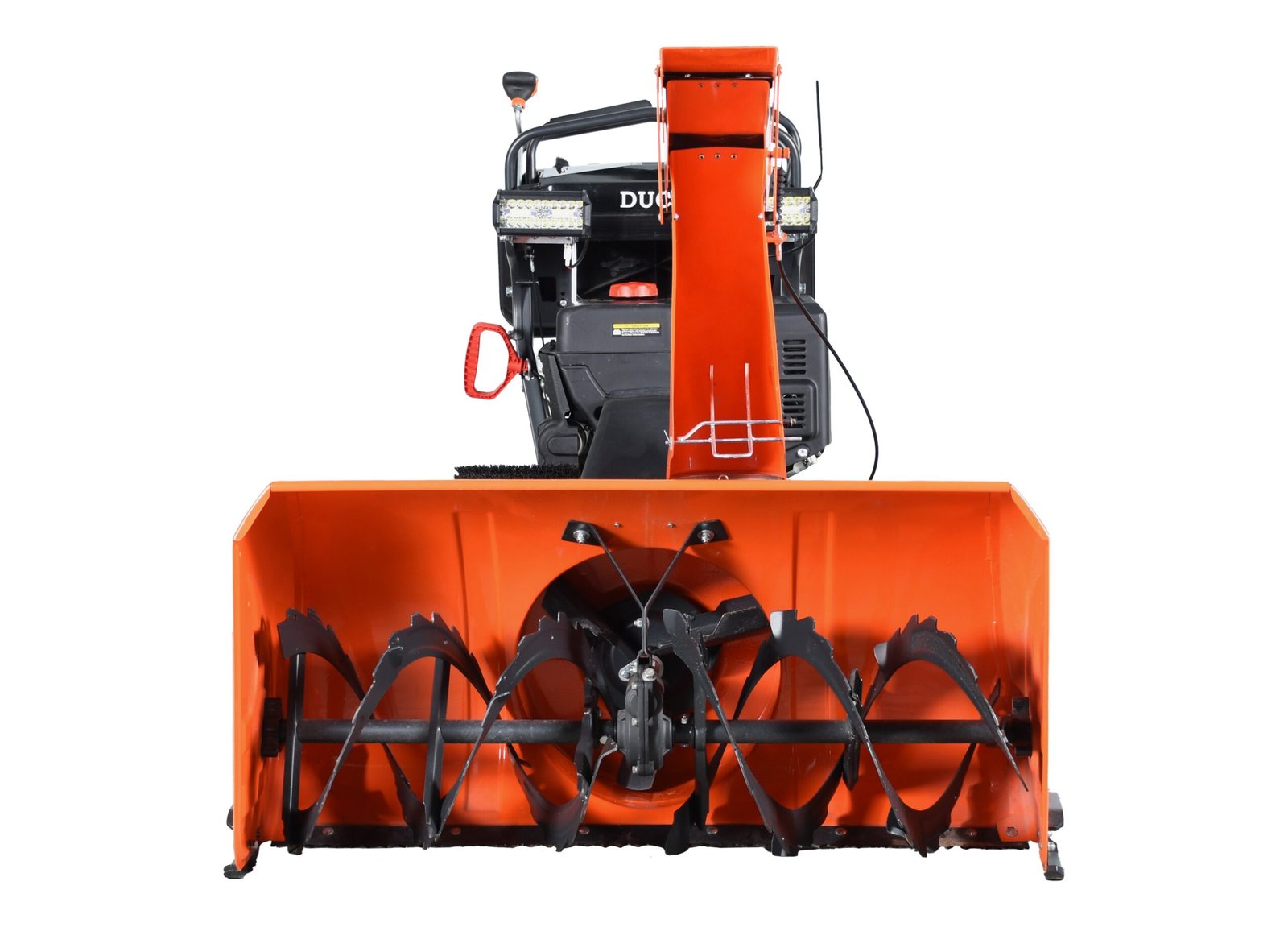
Canadian standards for outdoor power equipment are published by the CSA Group. Gate width limits snow blower sizes more than budget does.
Every size we stock
71 machines with a stated clearing width, grouped by size. Prices are ours, in Canadian dollars. Snow blower sizes are the one specification you cannot change later.
| Width | Machines | Price range | What it is |
|---|---|---|---|
| 10 to 13 inch | 28 | $139.34 to $579.99 | Powered snow shovels, path clearing |
| 14 to 16 inch | 3 | $329.99 to $418.13 | Smallest true blowers, single stage |
| 17 to 18 inch | 4 | $278.75 to $557.51 | Compact single stage |
| 19 to 21 inch | 15 | $283.64 to $849.99 | Largest compact single stage |
| 22 to 24 inch | 10 | $320.56 to $3,199 | Mid size, single and two stage |
| 25 to 28 inch | 4 | $1,349 to $1,799 | Two stage, the suburban sweet spot |
| 29 to 34 inch | 5 | $1,299 to $2,399 | Large two stage, long drives |
| 35 inch and up | 2 | $1,029 to $5,999 | Tracked and attachment units |
Two things stand out. The 19 to 21 inch band is the deepest at 15 machines, which reflects where most Canadian buyers actually land. And the 22 to 24 inch band spans a very wide price range because it contains both single stage and cordless two stage machines. Comparing snow blower sizes on passes rather than inches is the useful method.
Passes by driveway and width
The honest way to compare sizes is passes, because passes are what take the time. These assume a small overlap between passes, which everyone leaves in practice. Compare snow blower sizes against your own driveway.
| Driveway | 16 inch | 20 inch | 24 inch | 28 inch | 34 inch |
|---|---|---|---|---|---|
| Single car, one length | 8 | 6 | 5 | 5 | 4 |
| Single car, double length | 15 | 12 | 10 | 9 | 7 |
| Two car, standard | 15 | 12 | 10 | 9 | 7 |
| Two car, double length | 30 | 24 | 21 | 17 | 14 |
| Rural lane | Not realistic | Not realistic | Slow | Workable | Comfortable |
Read across the two car standard row, the most common Canadian case. Going from 20 to 28 inches saves three passes. At roughly a minute a pass that is three minutes per clear, or about an hour across a twenty clear season. Real, but not transformative, and worth weighing against a machine that is heavier to turn twelve times and harder to store.
Now read the rural lane row. That is where width stops being a convenience and becomes the difference between a job you do and a job you avoid.
Choosing your width
Work through these in order.
- Measure the area you clear, not the property. Length times width of the actual driveway and any paths.
- Decide your acceptable clearing time. Fifteen minutes is a reasonable target for a suburban driveway. Use the passes table to find the width that meets it.
- Check the surface. Gravel means two stage regardless of width, which sets a floor of about 22 inches in practice.
- Check the plow. If the municipal plow banks your driveway every storm, two stage again.
- Now check storage and access, which is where the answer often gets revised downward.
Most people arrive at a larger machine than they need through step two and then discover step five. Doing five before you order saves a return. This is where snow blower sizes stop making a difference.
Measure the gate first
The most common sizing mistake has nothing to do with snow. It is buying a machine that will not fit where it has to go. All snow blower sizes above are in stock in Canada.
A standard garden gate is 36 inches. A snow blower is wider than its clearing width, because the housing and handles add several inches on each side. A 28 inch machine is often close to 32 inches overall, which passes a 36 inch gate with little room. A 34 inch machine usually does not.
Measure three things before ordering: the narrowest gate or passage the machine must pass through, the shed or garage door, and the floor space where it will live with room to walk around it. Also check whether it must be lifted over a step or a threshold, because weight matters far more then than it does on the driveway.
If the machine has to live outside under a cover, factor that in too. Salt and damp end more machines than snow does, and a unit stored badly will need parts sooner. Covers and wear parts are on the parts catalogue.
Width is not the only decision
Two machines of the same width can be entirely different tools, so width alone will not choose for you.
| Also decide | Options | What it changes |
|---|---|---|
| Stages | Single, two, three | Gravel safety, plow ridge capability, throw distance |
| Power | Petrol, cordless, corded | Runtime, maintenance, noise, cold behaviour |
| Drive | Wheels or tracks | Traction on slopes and ice |
| Start | Recoil or electric | How the first cold morning goes |
| Comfort | Heated grips, LED light | Whether you clear early or put it off |
The stage question overrides width entirely if your surface is gravel or the plow banks your driveway; both demand a two stage machine whatever size you were considering. Stages explained covers that, and two against three stage covers the step above it.
What we would suggest
Plain recommendations by situation, using sizes we actually hold.
| Your situation | Suggested width | Why |
|---|---|---|
| Steps, deck, one car apron | 10 to 13 inch powered shovel | Light, instant, stores anywhere |
| Short paved single car drive | 16 to 20 inch single stage | Finishes quickly, easy to store |
| Standard two car drive, paved | 21 to 24 inch | The best balance of time and bulk |
| Two car drive with a plow ridge | 25 to 28 inch two stage | Cuts the ridge instead of riding over it |
| Gravel surface, any size | 22 inch and up, two stage | Skid shoes lift the auger clear |
| Long or double length drive | 28 to 34 inch | Removes passes where passes hurt most |
| Rural lane or acreage | 34 inch and up, consider tracks | Throughput and traction both matter |
| Slope or persistent ice | Tracked, any width | Traction changes the job more than width |
If two rows describe you, take the larger of the two only if you have confirmed the storage and the gate. Otherwise take the smaller and clear twice during long storms, which is easier on you and the machine anyway.
Sizing for your season, not the average
The passes table assumes a normal fall. What actually decides whether a width is comfortable or marginal is how much snow your city gets and how often you clear.
| Seasonal snowfall | Typical of | Sizing effect |
|---|---|---|
| Under 150 cm | Calgary, Regina, Halifax | A smaller machine is genuinely fine |
| 150 to 220 cm | Edmonton, Winnipeg, London | Middle of the range, 21 to 24 inch |
| 220 to 300 cm | Ottawa, Barrie, Montreal | Lean larger, 24 to 28 inch |
| Over 300 cm | Quebec City, Saguenay, St. John’s | 28 inch and up, and consider tracks |
Frequency matters as much as total. Twenty light falls are easier on a small machine than eight heavy ones, even if the season totals match, because depth per clear is what strains a narrow machine rather than the annual figure.
Freeze and thaw is the other regional factor. Where snow melts at midday and refreezes overnight, you are often clearing a dense crust rather than fresh powder, and that pushes you toward two stage capability regardless of width.
The two sizing mistakes people make
Buying for the worst storm of the decade. It is tempting to size for the blizzard rather than the ordinary Tuesday. But you clear the ordinary Tuesday twenty times a season and the blizzard once every few years, and an oversized machine makes all twenty of those slower to get out, harder to turn and more awkward to put away. Size for the common case and clear twice when the rare one arrives.
Buying for the driveway you can see. People measure the parking area and forget the walkway to the door, the path to the shed, the gate, and the strip the plow banks at the road. Those add up, and they are often the parts you actually resent clearing. Count them before choosing a width.
Between them these two mistakes explain most of the machines that sit in garages while their owners shovel.
What power source is available at each size
Size and power source are linked in practice, because some combinations simply are not made. This is what exists in our range.
| Width | Corded | Cordless | Petrol |
|---|---|---|---|
| 10 to 13 inch | A few shovels | Most of the 28 | None |
| 14 to 21 inch | Yes, from $329.99 | Yes, the deepest choice | One 21 inch option |
| 22 to 24 inch | No | Yes, including two stage | Yes |
| 25 to 34 inch | No | Limited | The main option |
| 35 inch and up | No | No | Petrol and tracked only |
The practical reading: below 21 inches you can have any power source you like, and cordless is the deepest part of our range. Above 24 inches the choice narrows quickly, and above 28 inches petrol is effectively the answer.
That matters if avoiding an engine is a priority for you. If it is, decide the power source first and let it cap your width, rather than choosing a width and discovering it only comes with a petrol engine. Our electric side runs 27 Greenworks and 25 Snow Joe machines against 15 Ducar petrol, so there is real choice below the 24 inch line.
How snow blower sizes affect clearing time
To summarise: snow blower sizes comes down to matching the machine to the surface, the snowfall and the space you have to store it. Everything above is the detail behind that. If any of it is unclear for your property, ask us rather than guessing. All snow blower sizes here are listed by real clearing width.
Getting the size right is the cheapest decision
Width is the one specification you cannot change after purchase. Everything else can be worked around: a second battery pack extends runtime, a spare belt covers a breakdown, heated grips can be lived without. A machine that is too narrow for your driveway stays too narrow for a decade, and a machine too large for your gate never gets used properly. Season length shifts which snow blower sizes suit you.
That makes sizing worth ten minutes with a tape measure before you spend anything. Measure the driveway, count the passes from the table above, then measure the gate and the storage space and see whether the answer survives.
Prices across every band are on the Canadian price guide, reduced machines appear on the sale page, and the full method is in the buying guide.
Common questions
What size snow blower do I need for a 2 car driveway?
For a standard two car driveway, 24 to 28 inches is the usual answer, and 21 inches is workable if the season is moderate and the surface is paved. Width sets the number of passes, so a 28 inch machine finishes a standard driveway in about 9 passes against 12 for a 20 inch one. Measure your gate before you commit to anything over 26 inches. That is why snow blower sizes matter more than engine size.
Is a 24 inch snow blower big enough?
For most suburban Canadian driveways, yes. A 24 inch machine clears a standard two car driveway in roughly 10 passes, fits through most gates, and is still light enough to turn comfortably. It is the size we would suggest first if you have no unusual constraints. Ask us to match snow blower sizes to your property.
What is the difference between a 21 inch and a 28 inch snow blower?
Seven inches of width, which is about three fewer passes on a standard two car driveway, plus a large difference in weight, storage footprint and price. The 21 inch machines here are single stage and start at $283.64; the 25 to 28 inch band is two stage and runs $1,349 to $1,799. The gap is capability, not just size.
Does a bigger snow blower clear faster?
Yes, but less than people expect. Turning at the end of each pass costs the same regardless of width, so doubling the width does not halve the time. On a standard driveway the difference between 20 and 28 inches is a few minutes per clear. On a long rural lane it is substantial.
What size snow blower is best for a small driveway?
For a single car driveway or a short paved apron, 16 to 21 inches is ample and much easier to store. We list 22 machines in that range from $278.75. Below 14 inches you are into powered snow shovels, which clear a path rather than throwing snow clear.
Browse by type: compact machines, single stage, two stage, battery and corded electric. If you would rather describe your driveway to a person, use the contact page.