
This is Canada snowfall by city, all 52 of them, ranked by how much snow actually falls in a season and matched to the clearing width we would fit. The spread is 13.4x from top to bottom, and it is the reason a single national buying guide gets so many Canadians the wrong machine.
The 52 city ranking
Every figure below is the average season total for that city. Click a city to read the full guide, which covers the local plow pattern, the terrain and where people actually put the snow.
| Rank | City | Province or territory | Season snowfall | Clearing width we would fit |
|---|---|---|---|---|
| 1 | St Johns | Newfoundland and Labrador | 335 cm | 30 inch two stage |
| 2 | Saguenay | Quebec | 330 cm | 30 inch two stage |
| 3 | Quebec City | Quebec | 303 cm | 28 to 30 inch two stage |
| 4 | Sault Ste Marie | Ontario | 296 cm | 30 inch two stage |
| 5 | Sherbrooke | Quebec | 287 cm | 28 to 30 inch two stage |
| 6 | North Bay | Ontario | 274 cm | 28 to 30 inch two stage |
| 7 | Charlottetown | Prince Edward Island | 268 cm | 28 to 30 inch two stage |
| 8 | Sudbury | Ontario | 267 cm | 28 to 30 inch two stage |
| 9 | Moncton | New Brunswick | 264 cm | 28 to 30 inch two stage |
| 10 | Barrie | Ontario | 253 cm | 28 to 30 inch two stage |
| 11 | Fredericton | New Brunswick | 232 cm | 26 to 30 inch two stage |
| 12 | Saint John | New Brunswick | 226 cm | 28 to 30 inch two stage |
| 13 | Gatineau | Quebec | 224 cm | 26 to 30 inch two stage |
| 14 | Ottawa | Ontario | 223 cm | 26 to 30 inch two stage |
| 15 | Montreal | Quebec | 210 cm | 26 to 30 inch two stage |
| 16 | Laval | Quebec | 205 cm | 26 to 28 inch two stage |
| 17 | Prince George | British Columbia | 202 cm | 26 to 30 inch two stage |
| 18 | Longueuil | Quebec | 200 cm | 26 to 28 inch two stage |
| 19 | London | Ontario | 194 cm | 26 to 30 inch two stage |
| 20 | Thunder Bay | Ontario | 185 cm | 26 to 30 inch two stage |
| 21 | Peterborough | Ontario | 174 cm | 26 to 30 inch two stage |
| 22 | Kingston | Ontario | 168 cm | 26 to 28 inch two stage |
| 23 | Kitchener | Ontario | 160 cm | 24 to 28 inch two stage |
| 24 | Guelph | Ontario | 159 cm | 24 to 28 inch two stage |
| 25 | Yellowknife | Northwest Territories | 155 cm | 26 to 28 inch |
| 26 | Halifax | Nova Scotia | 154 cm | 26 to 28 inch two stage |
| 27 | Cambridge | Ontario | 152 cm | 24 to 28 inch two stage |
| 28 | Hamilton | Ontario | 150 cm | 24 to 28 inch two stage |
| 29 | Grande Prairie | Alberta | 145 cm | 24 to 28 inch two stage |
| 30 | Whitehorse | Yukon | 145 cm | 26 to 28 inch |
| 31 | Red Deer | Alberta | 143 cm | 24 to 28 inch |
| 32 | Oshawa | Ontario | 137 cm | 24 to 26 inch |
| 33 | Calgary | Alberta | 129 cm | 22 to 26 inch |
| 34 | Edmonton | Alberta | 124 cm | 24 to 26 inch |
| 35 | St Catharines | Ontario | 122 cm | 22 to 26 inch |
| 36 | Lethbridge | Alberta | 118 cm | 24 to 26 inch |
| 37 | Brandon | Manitoba | 118 cm | 24 to 26 inch |
| 38 | Prince Albert | Saskatchewan | 118 cm | 24 to 28 inch |
| 39 | Toronto | Ontario | 115 cm | 22 to 26 inch |
| 40 | Winnipeg | Manitoba | 114 cm | 24 to 26 inch |
| 41 | Windsor | Ontario | 111 cm | 22 to 24 inch |
| 42 | Brampton | Ontario | 110 cm | 22 to 26 inch |
| 43 | Mississauga | Ontario | 108 cm | 22 to 24 inch |
| 44 | Saskatoon | Saskatchewan | 106 cm | 22 to 26 inch |
| 45 | Regina | Saskatchewan | 101 cm | 22 to 26 inch |
| 46 | Moose Jaw | Saskatchewan | 96 cm | 22 to 26 inch |
| 47 | Kamloops | British Columbia | 71 cm | 21 to 24 inch |
| 48 | Burnaby | British Columbia | 45 cm | powered shovel or 21 inch single stage |
| 49 | Nanaimo | British Columbia | 45 cm | powered shovel or 21 inch single stage |
| 50 | Surrey | British Columbia | 41 cm | powered shovel or 21 inch single stage |
| 51 | Vancouver | British Columbia | 38 cm | powered shovel or 21 inch single stage |
| 52 | Victoria | British Columbia | 25 cm | powered shovel |
Five things the ranking shows
The national spread is 13.4x. St Johns takes 335 cm a season. Victoria takes 25 cm. Those two households are not in the same market, and no single recommendation covers both. The average across all 52 cities is 167 cm and the median is 153 cm.
The Prairies get less snow than Toronto. Regina averages 101 cm and Saskatoon 106 cm, both under Toronto at 115 cm. Moose Jaw at 96 cm is the least snowy place in the set outside British Columbia. Prairie winters are brutal because of cold, wind and drifting, not because of depth. That still argues for a two stage machine, but for a different reason than most buyers assume.
The far North is not the snowiest part of Canada. Yellowknife takes 155 cm and Whitehorse 145 cm, both well below Montreal at 210 cm and less than half of Quebec City at 303 cm. Cold, dry air holds less moisture. What the North demands is a machine that starts at minus 40, which is a different specification from a machine that moves depth.
Eastern Canada is in a category of its own. Quebec averages 251 cm across its seven cities and New Brunswick 241 cm, against 177 cm for Ontario and 105 cm for Saskatchewan. Eighteen of the 52 cities sit at or above 200 cm a season, and fourteen of those eighteen are in Quebec, Atlantic Canada or northern Ontario.
British Columbia contains the widest range in the country. Prince George takes 202 cm while Victoria takes 25 cm, an eightfold gap inside one province. Any guide that treats British Columbia as one climate is wrong about most of it.
Snowfall by province and territory
Averaged across the cities in this dataset. Provinces represented by a single city are shown for completeness rather than as a provincial average.
| Province or territory | Cities in this set | Average | Lowest | Highest |
|---|---|---|---|---|
| Newfoundland and Labrador | 1 | 335 cm | 335 cm, St Johns | 335 cm, St Johns |
| Prince Edward Island | 1 | 268 cm | 268 cm, Charlottetown | 268 cm, Charlottetown |
| Quebec | 7 | 251 cm | 200 cm, Longueuil | 330 cm, Saguenay |
| New Brunswick | 3 | 240 cm | 226 cm, Saint John | 264 cm, Moncton |
| Ontario | 19 | 176 cm | 108 cm, Mississauga | 296 cm, Sault Ste Marie |
| Northwest Territories | 1 | 155 cm | 155 cm, Yellowknife | 155 cm, Yellowknife |
| Nova Scotia | 1 | 154 cm | 154 cm, Halifax | 154 cm, Halifax |
| Yukon | 1 | 145 cm | 145 cm, Whitehorse | 145 cm, Whitehorse |
| Alberta | 5 | 131 cm | 118 cm, Lethbridge | 145 cm, Grande Prairie |
| Manitoba | 2 | 116 cm | 114 cm, Winnipeg | 118 cm, Brandon |
| Saskatchewan | 4 | 105 cm | 96 cm, Moose Jaw | 118 cm, Prince Albert |
| British Columbia | 7 | 66 cm | 25 cm, Victoria | 202 cm, Prince George |
Why snowfall alone does not size a machine
Season total is the first input, not the answer. Four other things move the recommendation, and on a lot of driveways they move it further than snowfall does.
Surface. Gravel rules out a single stage machine at any snowfall, because a single stage auger touches the ground by design and will throw stone. On gravel the floor is a two stage machine with adjustable skid shoes, even in a 100 cm city.
The plow ridge. What the municipality leaves across the end of your driveway is denser than anything that fell from the sky, and it is the load that defeats undersized machines. A city that plows early and often leaves a smaller ridge more frequently. A city that waits for the storm to finish leaves one big compacted bank. The plow ridge guide covers how to read your own street.
Slope and where the snow goes. A short flat drive with open lawn on both sides is easy at 250 cm. A sloped drive hemmed in by a fence is hard at 120 cm, because you run out of anywhere to put what you remove and you start needing throw distance rather than intake width.
Snow density. Coastal wet snow near the Strait of Georgia weighs far more per centimetre than the dry snow that falls on the Prairies. Vancouver at 38 cm and Moose Jaw at 96 cm feel closer than the numbers suggest, because the coastal snow arrives heavy.
Snowfall bands and machine sizes
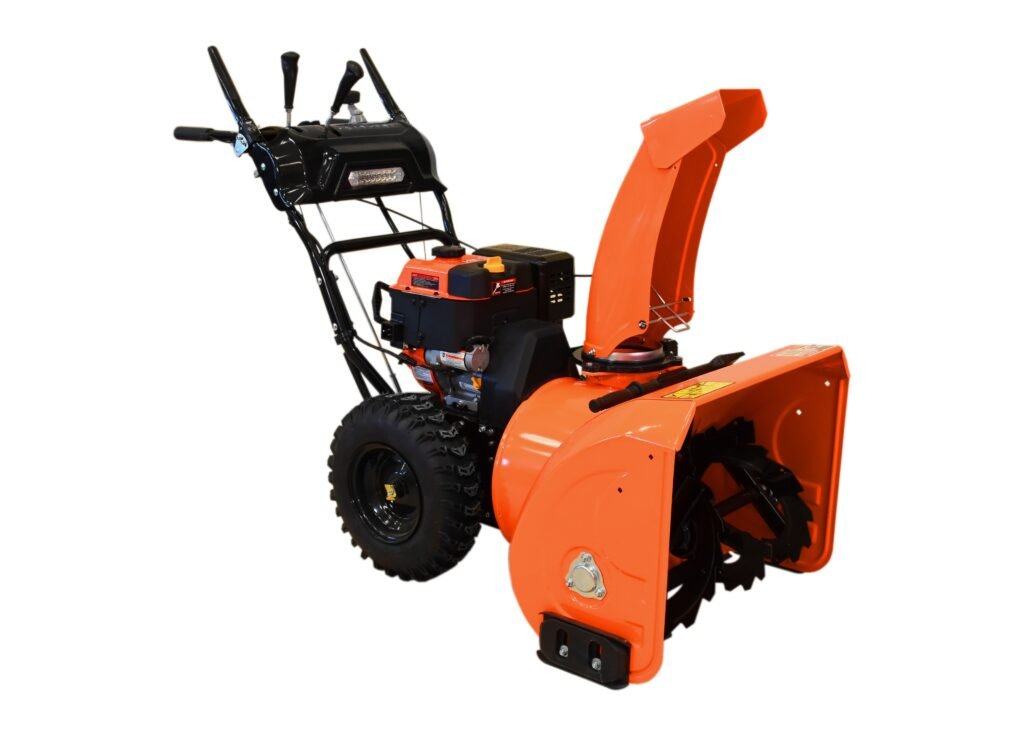
The bands below are how we translate a season total into a starting point. Treat them as the floor, then adjust for surface, slope and plow ridge. The snow blower size calculator does this arithmetic for you and asks about the other four factors.
| Season snowfall band | What we would fit | Cities in this band |
|---|---|---|
| Under 60 cm | Powered shovel, or a 21 inch single stage if you have a long drive | Victoria, Vancouver, Surrey, Burnaby, Nanaimo |
| 60 to 120 cm | 21 to 24 inch single stage on pavement, 24 inch two stage on gravel | Kamloops, Moose Jaw, Regina, Saskatoon, Mississauga, Brampton, Windsor, Toronto, Winnipeg |
| 120 to 180 cm | 24 to 28 inch two stage | Lethbridge, Brandon, Prince Albert, Edmonton, Calgary, St Catharines, Oshawa, Red Deer, Whitehorse, Grande Prairie, Hamilton, Cambridge, Halifax, Yellowknife, Guelph, Kitchener, Kingston, Peterborough |
| 180 to 250 cm | 26 to 30 inch two stage, tracks worth considering on a slope | Thunder Bay, London, Longueuil, Prince George, Laval, Montreal, Ottawa, Gatineau, Saint John, Fredericton |
| Above 250 cm | 28 to 30 inch two stage, tracked if the drive is sloped or long | Barrie, Moncton, Sudbury, Charlottetown, North Bay, Sherbrooke, Sault Ste Marie, Quebec City, Saguenay, St Johns |
Full guides for every city in the table are collected on the snow blowers by city hub, and the sizing guide explains the reasoning behind each band.
Where these numbers come from
Each figure is the average annual snowfall for that city, expressed in centimetres of snow that fall in a season rather than depth on the ground at any moment. Canadian climate normals are published by Environment and Climate Change Canada, whose station data is the reference for this kind of figure, and the underlying observing programme is described by the Government of Canada.
Three caveats worth stating plainly. Snowfall varies year to year, so a season total is a planning figure and not a forecast. City figures come from an official station that may sit some distance from any given neighbourhood, and lake effect bands in particular can double the total a few kilometres away. And a season total says nothing about how the snow arrives: three 40 cm storms and forty 3 cm days add to the same number and call for different machines.
The clearing width column is our own recommendation rather than published data. It is the size we would fit for a typical detached driveway in that city, and it is the same logic the calculator applies.
Use this data, with credit
This table is free to quote, republish or build on. We would rather see the numbers used correctly than kept behind a form, so there is no gate and no signup.
The full dataset is available as a CSV file with rank, city, province, season snowfall and suggested clearing width: download the Canada snowfall by city dataset.
If you use it, this is the credit line we ask for:
Snowfall figures compiled by Snow Blowers Canada.
Journalists and site owners who want a cut of the data in another format, a province by province breakdown or a chart image, can ask through the contact page and we will put it together.
Frequently asked questions
How much snow does the average Canadian city get in a season?
Across the 52 cities in this dataset the average season total is 167 cm and the median is 153 cm. The average is pulled upward by the eastern cities, so the median is the more useful number for a typical Canadian driveway. Half of these cities sit below 153 cm a season.
Which Canadian city gets the most snow?
Of the 52 cities here, St Johns, Newfoundland and Labrador leads at 335 cm a season, followed by Saguenay, Quebec at 330 cm and Quebec City at 303 cm. The snowiest place in Ontario is Sault Ste Marie at 296 cm, which is well ahead of any city in the Greater Toronto Area.
Which Canadian city gets the least snow?
Victoria, British Columbia at 25 cm a season. Vancouver follows at 38 cm and Surrey at 41 cm. These are the only cities in the set where most households genuinely do not need a snow blower, and a powered shovel is the honest answer.
Do the Prairies get more snow than Ontario?
No, and this is the single most common assumption the data contradicts. Regina averages 101 cm and Saskatoon 106 cm, both below Toronto at 115 cm. The Prairies are cold and windy rather than deep. What makes prairie clearing hard is drifting and hardpack, not season totals, which is why we still fit a two stage machine there.
Does more snowfall always mean a bigger snow blower?
No. Snowfall sets the floor, not the answer. A 120 cm city with a gravel lane, a slope and a municipal plow that leaves a hard ridge across the apron can need more machine than a 200 cm city with a short paved drive that is cleared early. Surface, slope, where the snow goes and plow behaviour all move the recommendation.
Why does coastal British Columbia need a different machine?
Coastal snow near the Strait of Georgia falls wet and heavy and usually melts within days. Wet snow at 38 cm a season punishes an underpowered single stage auger and rewards a powered shovel or a small single stage machine, because the problem is weight per centimetre rather than depth over a season.
Can I reuse these snowfall figures?
Yes. The table is free to cite or republish with a link back to this page. There is a ready made credit line further down, and the whole dataset is available as a CSV file so you do not have to retype it.