
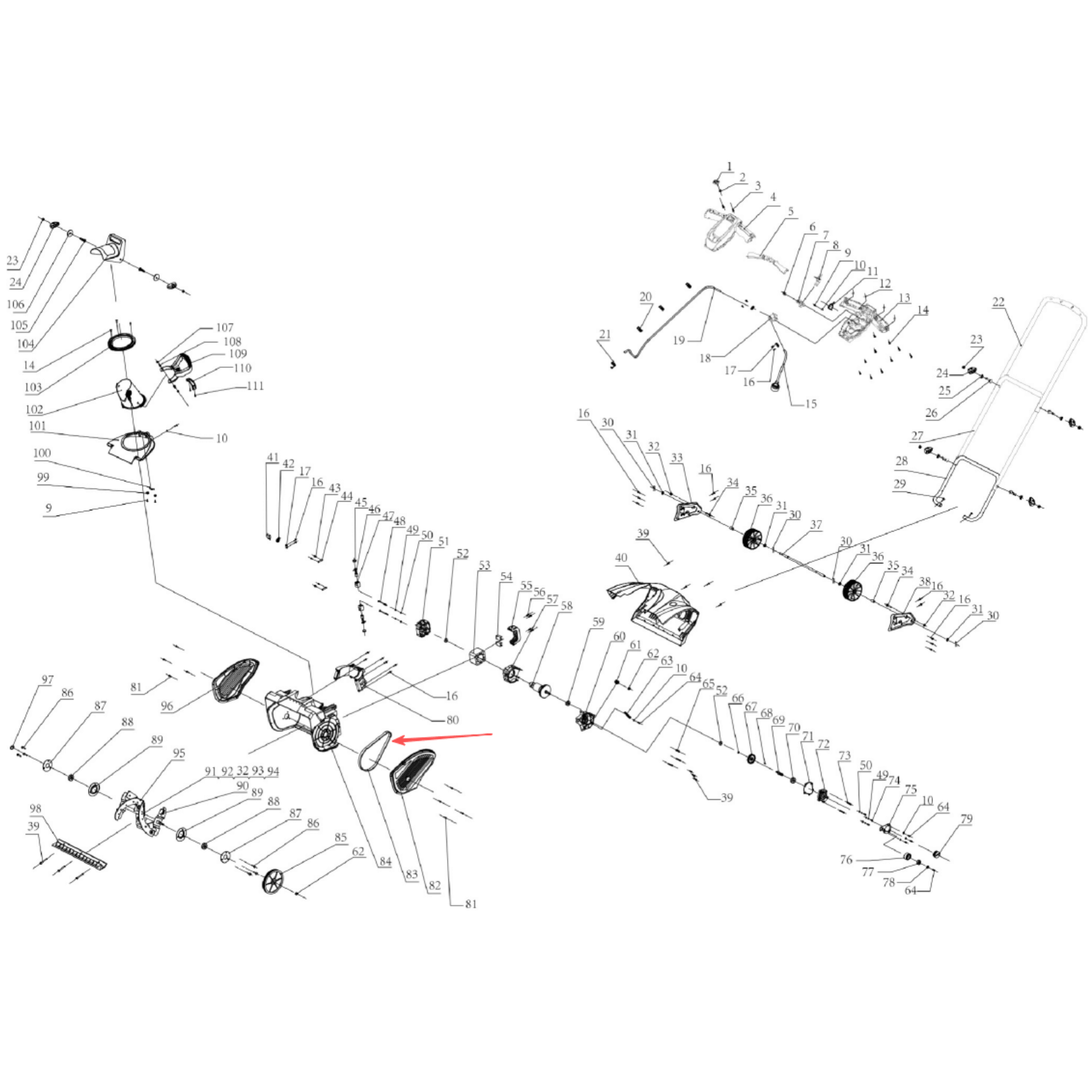
The 5PJ660 auger belt is stock number 302040024, a five rib belt on the PJ profile. PJ sits next to PK in every catalogue and the two are routinely confused, which is unfortunate because they are not interchangeable in either direction. Here is the honest picture on this 5pj660 auger belt, written for Canadian conditions rather than for a catalogue.
On this page
Choosing a 5pj660 auger belt for a Canadian driveway
Both are metric ribbed profiles and both work the same way, with shallow V ribs wedging into matching grooves. The difference is the rib pitch, meaning how far apart the ribs sit.
| Profile | Rib pitch | Rib depth | Typical use |
|---|---|---|---|
| PJ | 2.34 mm | Shallower | Compact drives, small pulleys, lighter loads |
| PK | 3.56 mm | Deeper | Higher torque, larger pulleys |
So a 5PJ660 auger belt has five ribs spaced 2.34 mm apart. A five rib PK belt would have its ribs 3.56 mm apart and be noticeably wider overall. Put a PJ belt on a PK pulley and the ribs land partly on the grooves and partly on the peaks between them, which supports the belt on rib tips and destroys it in short order.
Specifications
| Specification | Detail |
|---|---|
| Stock number | 302040024 |
| Belt code | 5PJ660 |
| Ribs | 5 |
| Profile | PJ, 2.34 mm rib pitch |
| Effective length | 660 mm |
| Interchangeable with PK | No |
Telling a 5pj660 auger belt from PK with a rule
You do not need a gauge. You need a rule with millimetres and a bit of care.
Lay the belt rib side up and measure across the full ribbed width, then divide by the number of ribs. A 5PJ660 auger belt measures roughly 11.7 mm across five ribs, because five times 2.34 is 11.7. A five rib PK belt measures about 17.8 mm, because five times 3.56 is 17.8. That is a 6 mm difference on a belt you can hold in one hand, which is easy to see once you know to look.
Measuring across all the ribs and dividing is far more accurate than trying to measure one rib. The same trick works for tooth pitch on synchronous belts, and for the same reason.
If the code is still legible on the belt back, use that instead. It is always the fastest answer.
Why a 5pj660 auger belt suits a compact drive
The finer profile is not a cheaper version of PK. It is chosen deliberately when the drive has small pulleys.
A shallower rib means a thinner belt overall, and a thinner belt bends around a tight radius with less internal strain. Every time a belt wraps a pulley the inner face compresses and the outer face stretches, and the thicker the belt the more violent that is. On small pulleys a thick belt runs hot and cracks; a 5pj660 auger belt does not.
The trade is torque capacity per rib, which is why PJ belts usually carry more ribs. Five shallow ribs on a fine pitch add up to a belt that can drive a real load while still turning corners a PK belt would struggle with.
Fitting a 5pj660 auger belt
Power disconnected, cover off, routing photographed. Then the ribbed belt discipline: confirm every rib is in a groove, not one groove out with an end rib on the land.
Sight along both pulleys from the side and check the belt edges line up flush. Then turn the drive by hand through several revolutions and watch for the belt walking sideways. Creep means the pulleys are out of plane, and a fine pitch belt tolerates that even less than a coarse one because its ribs are shallower.
Do not over tension it. Ribbed belts need less tension than an equivalent V belt, and excess tension goes straight into the shaft bearings. Our maintenance checklist covers where this fits in the pre season routine.
What goes wrong with a 5pj660 auger belt
Three failure patterns, and only the first is ordinary wear.
Rounded rib tips. The expected end of life. As the peaks flatten the belt sits deeper, the wedge effect weakens and grip falls away gradually. You notice it as reduced performance under load before you notice it visually.
Edge shredding. Misalignment. With ribs this shallow there is very little holding the belt laterally, so pulleys out of plane let it walk until the outer rib climbs a land and tears. Fix the alignment or the replacement goes the same way.
Cracking between ribs. Age and cold. Rubber hardens with time, and a hard belt flexed around a small pulley at minus 20 splits at the point of tightest bend. This is why a belt that has sat unused for years is not a good belt, and why local winter temperatures matter to belt life. Environment and Climate Change Canada climate data has the climate data for your own address.
Parts to order with a 5pj660 auger belt
The belt most often confused with this one, and the part that decides whether it lasts.
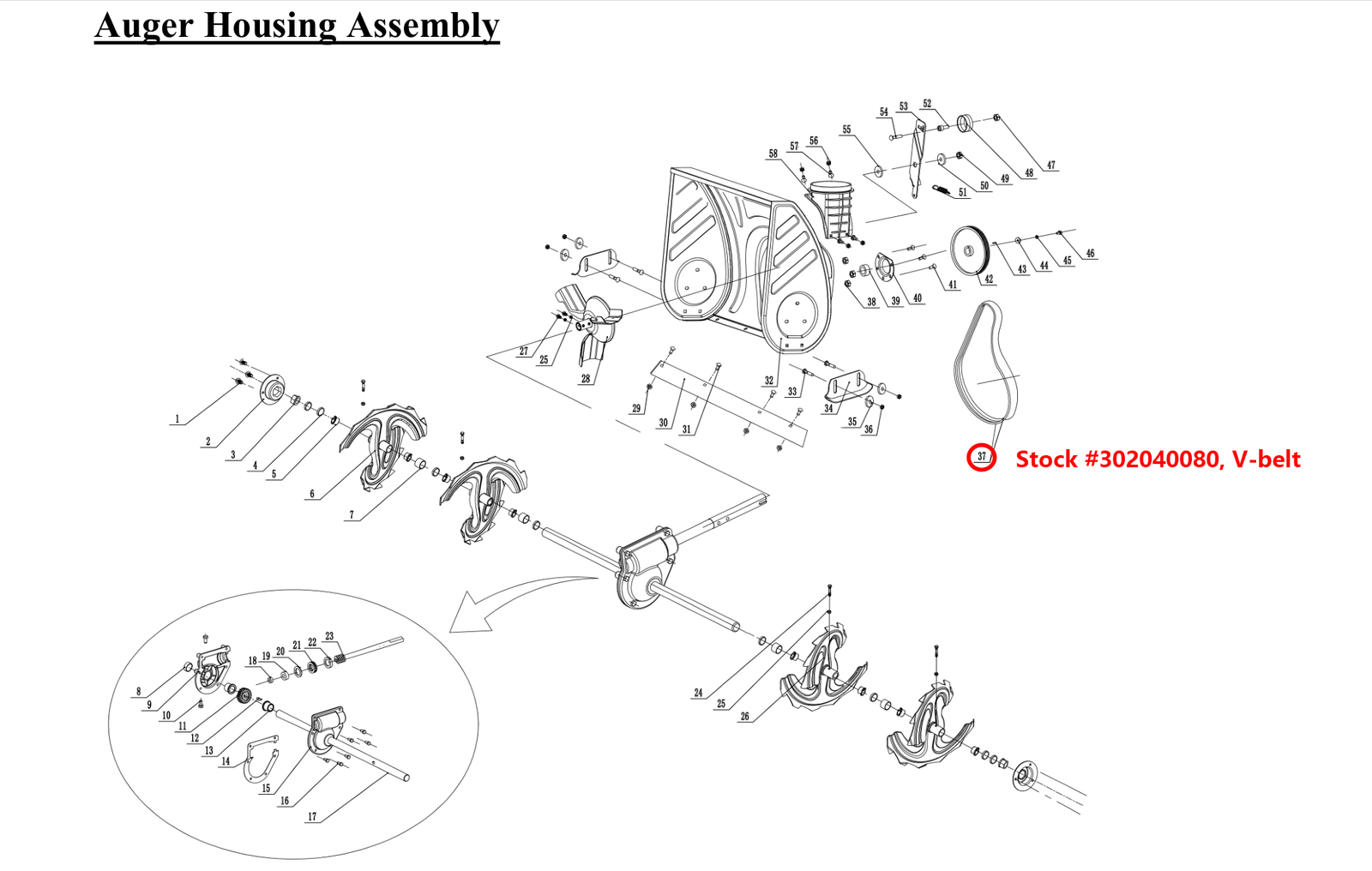
Multi-Wedge Belt (4PK 660mm): identical 660 mm length and a different rib pitch, which is exactly how they get confused.
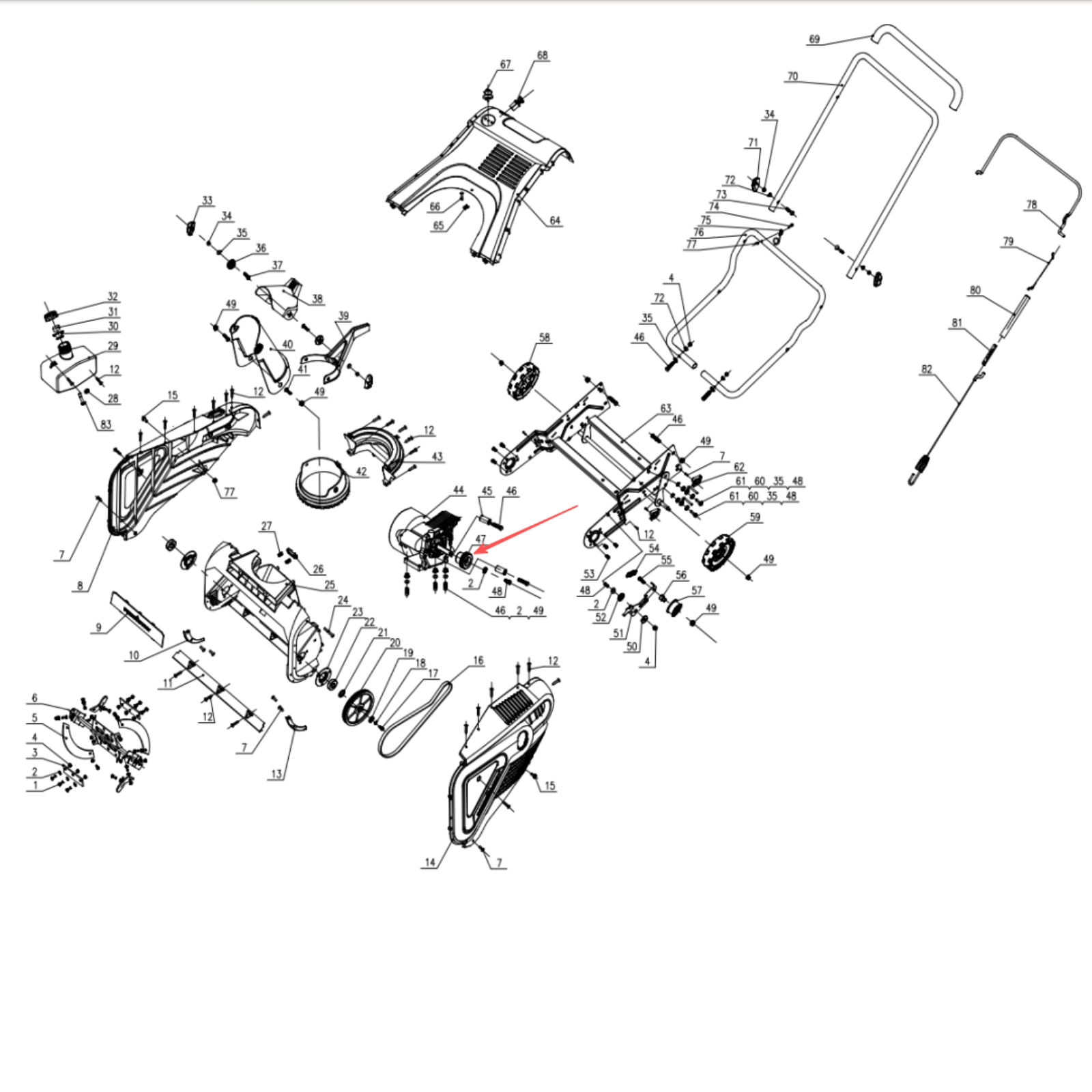
Small Belt Pulley: a PK pulley will not carry a PJ belt, so confirm the pulley if you are unsure.
Common questions
What is the difference between PJ and PK?
Rib pitch. PJ ribs sit 2.34 mm apart and PK ribs 3.56 mm apart. The pulleys are cut to match, so the two profiles never interchange.
How do I tell which one I have?
Measure across all the ribs and divide by the rib count. Five PJ ribs measure about 11.7 mm total, five PK ribs about 17.8 mm.
What happens if I fit a PJ belt on a PK pulley?
The ribs land partly in grooves and partly on the peaks between them, so the belt rides on rib tips and wears out very quickly.
Why does this drive use a fine profile?
Small pulleys. A shallower rib means a thinner belt, which bends around a tight radius without the internal strain that makes a thick belt run hot and crack.
Why does a PJ belt have more ribs?
Each shallow rib carries less torque than a deep one, so more ribs are used to reach the same capacity.
Should I tension it like a V belt?
No, less. Ribbed belts need lower tension, and excess tension is carried straight into the shaft bearings.
Reviews
There are no reviews yet.